Showing posts with label 1930s. Show all posts

Monday, August 29, 2016

370. PATRIOTIC AND POLITICAL PINBACKS

Buttons up!
A handful of pinbacks and buttons mostly with nationalistic and poltical themes--TOP: A Philippine seal enamel button (1960s), a Red Cross button (1920s), a LABAN sign pin (1980s), Teves for Senator pinback (Lorenzo Teves, elected as senator in 1967, appointed governor of Negros Oriental in 1978), and "Iboto Natin si Mercado" (unidentified political candidate, 1960s.).

Thursday, May 19, 2016

367. NEEDFUL THINGS

An old and small glass-fronted counter cabinet makes an excellent display to my miniatures, figurines, and small collectibles--bottle, bisque dolls, advertising premiums, coin banks, cake toppers. Whenever I go home with small, but precious finds, I dunk everything in here. Space-saving and neat!!Now where did I put my car keys??

Monday, April 11, 2016

365. Collectibles Ahoy! S.S.PRES. MCKINLEY SOUVENIR INKWELL & MENU CARD
S.S.President McKinley was a president liner operated by the Dollar Steamship Lines that served the world--from Boston in the U.S., Asia and Europe--under Commander Robert E.Carey U.S.N.R.. The passenger ship also served Manila, and to to go from the Philippines to the U.S. in the 1930, a passenger had to board the ship in the capital city, then proceed to Hong Kong, Shanghai, Kobe, Yokohama, Honolulu, Seattle, then to San Francisco. To get to the East Coast, the ship had to proceed down to Balboa,through the Panama Canal, then Havana and finally to New York or Boston.
The long and arduous trip was somehow made pleasant with a delicious all-day menu that featured an array of breakfast items--fresh Philippine mangos and rice included.
A souvenir inkwell was presented to passengers--made from real Philippine shells. The figure of the sailing steamship is hand-painted on a mother-of-pearl shell backdrop, while the inkbottle rests on a sandy base, with more shells--small tritons and clams. Found in an estate sale, these 1930s  transport collectibles are nostalgic mementos of the great era of shipping---when the most adventurous way to see the world was to get on board a ship, and sail the seas!!

Monday, November 2, 2015

349. Save the World: GLOBE BANK by J. CHEIN

This small tin collectible in an antique shop caught my eye because it was a small globe and a coin bank in one. Now what a swell idea to teach geography and thriftiness in one multi-function object! It was made by Julius Chein & Company, an American toy manufacturer (1903-1980s) that was popular for making mechanical toys made from stamped and lithographed tin.They also made licensed toys of companies  such as King Features Syndicate and Walt Disney Productions, producing Popeye, Felix the Cat and various Disney character toys.
What is even more fascinating is that, this old piece contains the old names of several countries no loner in use today--like Siam (for Thailand), Persia (now Iran), Belgian Congo (now Democratic Republic of Congo) and French West Africa, until 1960, a federation of 8 French African territories.This small bank, no more than 4 inches tall, is complete with its metal stopper at the bottom, to gain access to coins when it is full. "Be thrifty, but not covetous", a saying goes. Unfortunately, when it comes to collecting, I can't be both!

Thursday, October 1, 2015

346. A Collectible Flying High: CAST METAL GRAF ZEPPELIN TOY

The Graf Zeppelin was a German-made airship that was hydrogen-filled to make it fly. It was able to carry passengers and commercial flights were made from 1928 to 1937. Named after German pioneer Graf (Count) Ferdinand von Zeppelin, the Graf Zeppelin made histoiry when it made a round-the-world flight in 1929.
The novel airship was celebrated throigh various memorabilia and souvenirs that included commemorative coins, postcards, badges and even toys such as this 1930s cast metal painted 3-wheeled blimp, a scarce artifact from the airship days. It is about 8.5 inches long and weighs a hefty 2 pounds.
This Graf Zeppelin pull toy must have been cared for by its previous owners as most of its paint is intact, with just a few scruffs to show, after all these years. It must have been de-commissioned from flying! Zeppelins never reached the Philippines--except this toy version which I won from ebay. Any vintage cast metal toy is prized...even more so when it is made in the likeness of an airship with an unlikely shape, propelled by gas fuel. A great revolution in the sky! Truly a hot, hot, (air) collectible!!

Wednesday, June 10, 2015

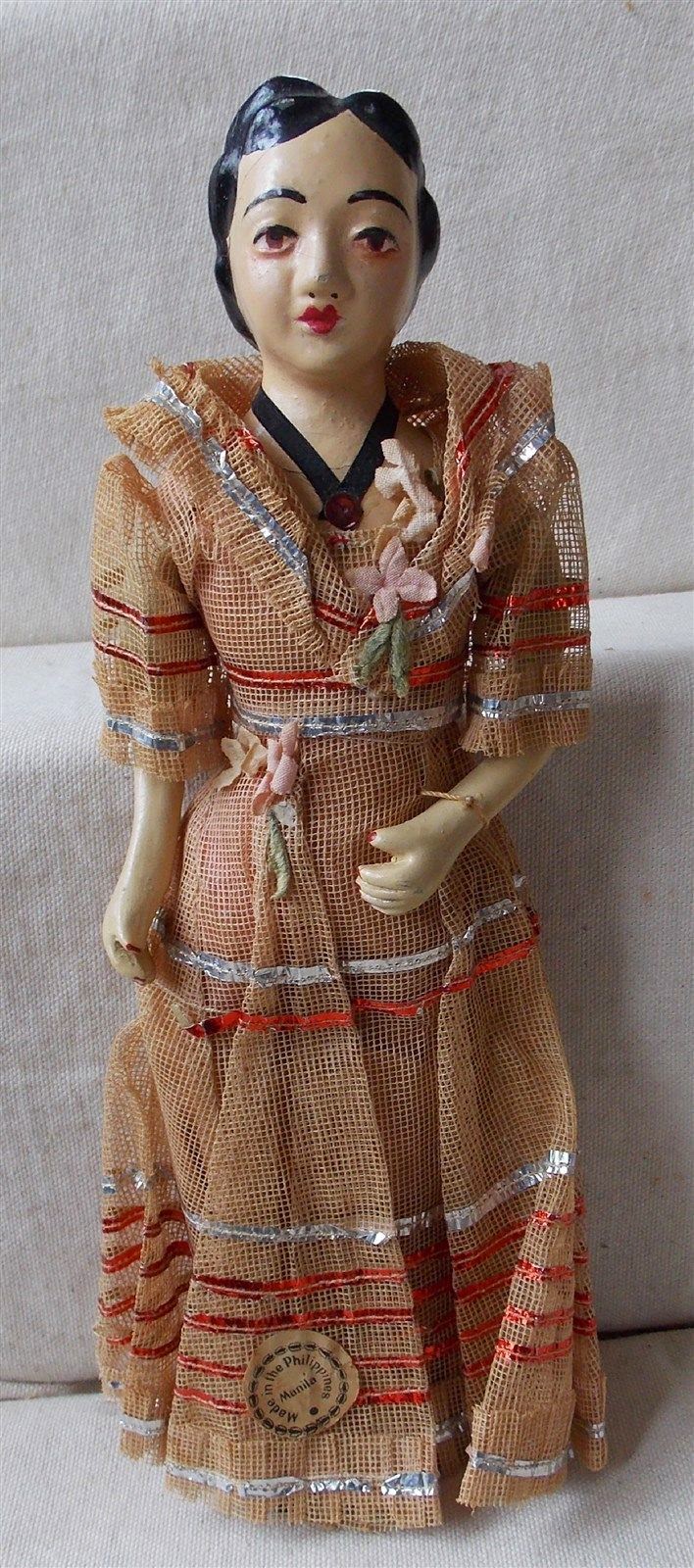
335. Among My Souvenirs: VINTAGE FILIPINA DOLL

In the 1930s--our peacetime era--tourism in the Philippines boomed. many bazaars and curio shops mushroomed in the Malate area, selling Philippine-made souvenirs to domestic and international tourist. Capiz shells, abaca products, woodcarvings, buri hats, banig (mats) and woven jusi and pina fiber were top sellers. For kids,there were a few options--yoyos and pull toys (calesas) for the boys, and for the girls--  Philippine-made dolls of composition with cloth bodies attired in baro't saya, like this example, in very good condition.
These were most likely outsourced from contractors who made these at home, products of Philippine cottage industry. They are very fragile, as the composition tend to crack over time, but this charming doll has retained its color, its dress and even its label. She is dressed in a stiffened abaca skirt and top, with a panuelo to complete her 'dalagang bukid' look.
These vintage Philippine dolls occasionally are seen on ebay--like this small 11 inch creation. Thank heavens, they are not that expensive and demand is not too high, so they are very much affordable. Much rarer are bigger dolls of over  a foot in length, made in the same fashion, but with heads of painted clay and more elaborate costumes. Dolls using raw Philippine materials are not just nostalgic souvenirs of childhood but wonderful examples of Philippine folk art.

Tuesday, June 2, 2015

334. Space Wars: BUCK ROGERS BOARDGAME

Buck Rogers first appeared in a short novel published by Philip Francis Nowlan in an August 1928 issue of the pulp magazine "Amazing Stories". Entitled  "Armageddon", it featured a hero,Anthony Rogers, later renamed Buck Rogers when it was bought by the  National Newspaper Syndicate. comic made its first newspaper appearance in 1929 . The adventures of Buck Rogers in comic strips, movies, radio and television became an important part of American popular culture. It's been credited with bringing into popular media the concept of space exploration. Buck Rogers' last incarnation was as a film in 1979 and as a TV series in 1981, starring Gil Gerard. Many merchandise such as toys and playthings were spawned by the TV serial--and this 1930s gameboard is just one of the hundreds of thousands that children played with. It's one of those basic "race" games--the movement is controlled by a throw of a dice or a spinner, with obstacles provided by "alien enemies" along the way.There were 3 game versions:"Cosmic Rocket Wars", "Search for the Secrets of Atlantis" and "The Siege of Gigantica".

Sunday, December 14, 2014

318. MANILA RAILROAD MILK PITCHER

In the U.S. one hot collectible field is Railroadiana--which refers to artifacts or items of current as well as defunct railways no longer in operation.This very rare specimen-- a small milk pitcher from the Manila Railroad Company is one such example. Passengers were served hot meals and drinks by uniformed railway staff, using tableware--plates, coffee cups, saucers-- bearing the MR logo. This surviving piece from the 30s, was offered by by a Manila collectible shop and it took little convincing for me to acquire it, as it's not only unique, but is also full of history.

The Manila Railroad Company was one of the largest domestic corporations in the Philippines from 1917 -1940's which the Philippine Government acquired in 8 Jan. 1917. Its railway lines totaled 1,140.5 in 1941, located in Luzon.  The lines extended from San Fernando, La Union, in the north, to Legaspi, Albay, in the south. The more important branches are the Paniqui-San Quintin, Tarlac-San Jose, Bigaa-Cabanatuan, San Fernando-Carmen, Calamba-Batangas, and College-Pagsanjan. The company was taken over by the U.S. military during World War II, to be used for the defense of the Philippines. The Manila Railroad Co., suffered irreparable losses from which it has never recovered, thus ending its operations.

Friday, September 19, 2014

309. So Big, Yet So Little: BIG LITTLE BOOKS

I found this neat cache of books in a little shop called Round Trip Collectibles--a collectible store in Metuchen, years ago. I think I paid 5 dollars for the lot--7 Big Little Books, as old as the late 1930s and as recent as the late 60s (in the case of Batman). These kiddie readings saw print first in 1932, published by the Whitman Publishing Company of Racine, Wisconsin. They were small, they were compact and had simple captioned drawings opposite each page of the text. They soon became big hits among children, so competitor like Saalfield, copied this format. Back then, each book cost just 10 cents each.  Great graphics, great stories, great size and price...what more can you ask for in a book?

Tuesday, August 19, 2014

306. Advertique: MENNEN POWDER TIN

POWDER TO THE PEOPLE! MennenTalcum For Men. Vintage powder tin, 5" high.

The Mennen Company was founded in 1878 by German immigrant, Gerhard Heinrich Mennen, who founded his company in Newark, then later moved to Morristown, New Jersey in 1953. The company's first product was talcum-based powder, an innovation at the time. Its product line expanded to include over-the-counter pharmaceuticals and personal products such as the Skin Bracer, Speed Stick, and Baby Magic products.
The men's line began with  "Mennen Talcum for Men."  and this example dates to the '30s. It was found in a local shop with its content almost full. Areas of missing paint are apparent--the paint on the tin is easily washed off.
The product graphics are still strong and unblemished in some parts, and the front panel even retains the image of the founder. Locally, the brand was overshadowed by Johnson & Johnso, which dominated the powder market. Mennen found a niche with its men's personal care line like skin bracer, deodorants and after-shaves. Mennen was later sold in the '90s to manufacturing giant, Colgate-Palmolive.

Sunday, June 22, 2014

301. Switch It While You Work: SNOW WHITE CHALKWARE LAMP

Walt Disney took moviedom by storm when it screened it screened its first animated feature, "Snow White and the 7 Dwarfs"  in 1937. Based on the fairy tale character, Snow White became a worldwide sensation and it popularized such songs as "When You Wish Upon a Star", "Someday, my Prince Will Come" and "Whistle While You Work". Snow White was the first of the so-called Disney Princess and is the only animated figure that has a star on the Hollywood Walk of Fame.
Immediately, licensed merchandise were made of the characters, especially the 7 Dwarfs--Grumpy, Happy, Doc, Bashful, Sneezy, Dopey and Sleepy. Snow White too, was immortalized in the form of dolls, gameboards, coloring books, figurines--and one of the earliest is this lamp base. La Mode Studios of New York was licensed to create these lamps made of painted plaster, in 1938. molded in the shape o Snow White. The drwafs too were cast as lamp bases, but the Snow White lamp--with a matching lampshade--remains a favorite. This particular lamp base however is very different from what La Mode created, so I assume this was from a different, unlicensed manufacturer, riding on the crest of the popularity of the cartoon. It bears no copyright date, but is incised with the Walt Disney name.
I found Snow White many years ago in Chatuchak market in Bangkok. Far from having a flawless fair complexion, she has a tan, almost like a morena Filipina. My Snow White came with a glass shade that does not really fit, which I believe to be a replacement. I am sure it can be rewired and restored (I actually repainted the scruffs on her body), and someday...her switch will come.

Sunday, April 20, 2014

296. Lord of the Tangles: TARZAN HAIR PRODUCT LABELS

An essential to manly good grooming in the 50s is a thick dab of pomada on your hair to keep hair licks in place and give your mane a noticeably brilliant sheen. Pomades like Brilliantine, Glo-Co, Bryllcreem, Verbena and Three Flowers were the leading brands of the day--guaranteed to turn one into a Rudolph Valentino, Clark Gable, James Dean or Elvis Presley.

One other popular brands was TARZAN, which not only manufactured a pomade (the greasy stuff was bottled in a small clear glass with a an aluminum cap) but also a whole line of hair grooming products like quality hair tonics and lotions--as these colorful labels show. The graphics are bold, the colors brilliant and the illustrations art deco-ish.

The brand name makes an allusion to the shiny, elegant locks of the Lord of the Jungle, exemplified by Johnny Weissmuller, who swang from tree to tree--always with hair in place. But while Tarzan had a lush head, but have you ever noticed that he has non-existent facial hair? I wonder why.

Wednesday, February 26, 2014

291. Advertiques: OLD COSMETIC PAPER LABELS

A selection of old paper labels of perfumes and cosmetics found in the Philippines, circa 1930s-50s. Some labels were embossed and made used of gold foil, featuring local names of flowers like "Ylang-Ylang", "Philippine Orchids" and "Azucena".
Products represented here include perfumes, lotions, pomade and talcum powder. Charming examples of early graphic design in Philippine product packaging.

Monday, January 27, 2014

289. FLAPPER COUPLE CAKETOPPER

Now here's a cake topper couple in a non-traditional pose. Instead of the stiff, formal figure of a bride and groom standing in rigid attention, these newlyweds are in a dancing mode, the bride in a winsome flapper dress that harkens back to the '30s.  Made of celluloid, this 3.5 inch bridal topper may have been produced in Japan. Cake toppers have been known since the turn of the 20th century. The first toppers were actual mini-dolls dressed to look like the bride and groom. Since then, they have been made of porcelain, bisque, plaster, plastic and fabric. The 50s were the heyday of cake toppers, and there is a growing horde of topper hoarders who collect these as wedding collectibles, mementos of a happy milestone in peoples' lives. To them, we say Best Wishes!!

Wednesday, January 8, 2014

286. BISQUE KIDS

Found this trio of bisque figures of kids--two girls in winter outfits and a little softballer. The heads are movable.. I'm almost sure they were made in Japan for the export market--I see these a lot in glass cabinets of many ancestral homes. No more than 3 inches tall, these adorable figurines sit perfectly on a wooden shadow box...not too precious, but still as decorative as they were made over 80 years ago!

Tuesday, December 31, 2013

285. Shadow Boxing: BAMBINO JESUS

Shadow box crafts seemed to be a popular hobby among Filipinos in the 20s and 30s as I have seen countless examples of all sorts---from boxing family portraits embellished with mother-of-pearl flowers, embroidered art, to religious tole art such as this 3-dimensional Bambino Jesus, pasted on a heavy board, then dressed in real cloth and accessorised with handcrafted symbols of his Passion as well as silk flowers. The shadow box dates from 1929--the back was lined with old newspapers dated from that era.
It's been said that these kinds of crafts were introduced by religious educators, evolved from some kind of monastic art that nuns dabbled with in the 19th century. Favorite motifs includ dressing up prints of the sacred Heart of Jesus and Mary, as well as the Holy Family. My Bambino box was purchased in Bulacan. The condition is fair to poor--the flowers are disintegrating, the lithographed cut-out of Jesus is starting to curl. Hopefully, I can have this restored soon! This kind of art is slowly vanishing, but it's never too late to try your hand at this--all you need are deft hands, some artistic skill and lots of imagination!

Sunday, December 15, 2013

283. For the Kid Chef: MINI-CLAY KITCHEN TOY UTENSILS

These three miniature clay kitchen utensils are all that's left of a large kitchen play set, made in the Philippines in the 1930s. The first to be  a "kendi", an almost-defunct Southeast Asian earthenware--at least in the Philippines--used as a drinking vessel and treasured by early Filipinos as a family heirloom. The next item looks like a clay version of a "tacho", those rund copper cooking pans with handles. The last is a very tiny "mangkok" or bowl. These simple Philippine toys of fired clay were sold in bazaars and tourist shops during the Commonwealth years, popular souvenirs from an American-controlled country finding its identity through its unique traditions in play and children's leisure.

Friday, November 1, 2013

278. BISQUE RIZAL BUST

An unusual Rizal bust made of bisque, an unglazed kind of ceramic, turned up recently for sale in San Fernando, and I quickly snapped it up as an addition to my Rizaliana bust collection. The 8 inch bust clearly identifies the national hero by way of his name etched on the front of the bust. Dating from 1930s, Rizal's likeness is pleasantly captured in this representation--although I find him a bit googly-eyed, don't you think? I've seen wooden Rizal busts, busts  made of cast cement and plaster--but not made of bisque, which was a favored material of European casters--French and German doll makers even made doll heads of this not-so-smooth, matte ceramic stuff. I just wonder if there's a Rizal bust out there made of China or porcelain?!

Saturday, September 7, 2013

272. I Pound It!: PHARMACY MORTAR & PESTLE

Pharmaceutical collectibles are few and far between--the most popular being medicien cabinets, "botica" signs (mostly medicine brands like Casfarina and Cortal), medicine bottles and thermometers.  Even rarer are phramacy equipments--like mortar and pestles ("dikdikan') that were traditionally used to crush various ingredients prior to preparing a prescription. I found this complete example from a newly-open antique shop at the famed Sta. Rita Exit of Bulacan.
The set is made of heavy brass--and very deep and tall--12 inches to be exact, dating from the 30s. Older examples were made of wood and porcelain, but my mortar and pestle is outstanding for its size and heft. Pharmacy was a popular course among ladies as early as the turn of the 20th century in the Philippines, a popular course in the early years of  U.P. and Centro Escolar de Senoritas. Graduates would go home back to their provinces to set up their "botica", personally preparing solutions, or crushing pills using their indispensable mortars and pestles.

Today, of course, these are becoming extincts in modern drugtores and pharmacists as the same medicine can come in many forms--liquid, powder, tablet. So, I'll probably stash this away in my kitchen and use it to pound peanuts for my favorite kare-kare. How's that for adaptive re-use?

Wednesday, May 29, 2013

263. COLLECTING RELIGIOUS MEDALS

 Medal collectors abound in the Philippines, judging from the number of medals and medallions offered at the regular Bayanihan Collector auctions in Manila. Few, however, collect religious medals, as they are not exactly on top of the list of medal collectibles--military medals, historical medals and commemorative medals are way up there. Now that's good news for religious medal collectors! Not only are prices stable and affordable, vintage medals of the sacred kind are also plentiful. They come in all sorts--made of cheap plastic, aluminum, brass, silver, and even gold.

Most common religious medals are those that mark feast days and anniversaries of saints (Virgen de La Naval, 400 years of Sto. Nino of Cebu), important religious events (e.g. National Eucharistic Congress). There are also souvenir medals from pilgrim sites (Shrine of our Lady of Lourdes, Fatima) and also celebrate the sacraments (Communion medals). Perhaps, the most well-known medal in the Philippines is Our Lady of the Miraculous Medal, the design of which was based on a vision by the French saint, Catherine Laboure.

Considered as sacramentals, religious medals are staples of Manila thrift shops and are regular offerings at the Greenhills Antique and Collectible shows. For the lazy shopper, there are local dealers on ebay Philippines that sell such medals too. The most sought after are the old medals showing the likenesses of Virgen de La Naval, or Our Lady of the Most Holy Rosary, patroness of the Philippines. Medals of the Nazareno and the Virgen de Antipolo are also prized. Medals, which contain relics, command higher prizes, as well as medals of gold and silver, as in the silver medals struck for the 1937 International Eucharistic Congress held in the Philippines.

Medals are best displayed in shadow boxes, or kept in plastic cases. I chose to show off mine in a tin glass-panelled urna inspired by those antique Mexican retablo cases. I hope I get a medal for creativity!