This picture showing a beautiful pair of Filipiniana busts was sent by phone to me for my consideration by my antique dealer from Bulacan. One look and I knew these were very rare pieces--and very old. The almost identical busts show two Filipinas in a typical Maria Clara outfit, characterized by a stiff
panuelo, covering their
camisa. One of the ladies has her head in a more tilted position and is about half an inch shorter, but both are carved similarly, right down to the hair caught in a bun at the back. There are polychrome traces on these fine softwood carvings.
I agreed with my dealer to see the busts up close on a Friday, as I really don't buy items without first seeing them--especially at the price he wanted. But towards the week, he phoned again to tell me that the middleman peddling the busts was pulling them out from his shop (he was taking them to Manila)--and asked f I could see them before Friday. That proved impossible for me, as I was still at work in Makati, so sadly, I passed them up. But the images of these rare Filipiniana pieces kept haunting me.
Next thing I knew, the pair appeared in an online shop in just a matter of days--sulit.com.ph--advertised by a Manila dealer. I quickly got in contact with the dealer and confirmed that the pair was still up for grabs. There was only one catch though--the original price had doubled! But at that point, i didn't care--the rarity of these pieces told me they were still worth much, much more.
I surmised that these were not commercially sold pieces but commissioned works from some sculptor meant to grace a grand old
bahay na bato. Their faces might have even been modelled from real Filipina ladies, sisters perhaps. Another possibility was that these were works of an advanced art student, projects of his sculpting class. The details are impeccable, right down to the turned pedestals and the lacey like edgings of the ladies'
panuelo.
But there was one more catch before I could even go check them out at the dealer's place: one bust had been sold. I would have wanted to get the pair, but I was still in luck: since I got to the dealer's place first, I had the first option to choose the bust of my preference. Of course, I picked the taller one, all 23 inches tall, showing a more mature lady of refinement and wealth. So ends my successful chase for this bust that had been the object of my fascination for a week--Maria Clara was mine to keep!




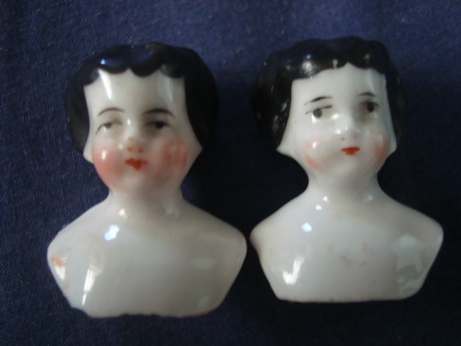 A pair of teensy-weensy china head dolls, no more than 3/4 inch high. They date from 1910-20 and are made in Japan, though the best and finest examples are from Germany. Painted china head dolls also came with separate arms and legs which could be assembled by an adept sewer on a cloth body, then dolled up in the latest fashion. These heads are so small, the dolls would probably measure about 5-6 inches when completed. I found them at Makati Cinema Square (whic sadly, is about to go!) and at the moment, I have no plans though of making cloth bodies for them--they're better off kept and seen in my shadow box, where they wll repose most likely for the rest of their doll lives.
 Now here are two nice finds from a Mabini antique shop: two calligraphic illustrations in their original frames, charming examples of turn-of-the century folk art, each dedicated by the maker to their object of affection. The first one is a birthday greeting for Pering, bearing the inscription:
 The second example carries a more profound, if not verbose, sentiments: "Anching, In your moments of meditation, let me be the subject of your inspiration with my most and sincere appreciation. Lucien. 18 Dec. 1934, Tuesday". Perhaps to balance this, the sender illustrated his paper tribute more simply, but using the same device of a flower with a cut-out center where a picture of Anching used to be. Drawn calendar pages are used to put in the sender's greetings.
 Handmade paper greetings such as these went out of style with the coming of commercially printed greeting cards. But hopefully, with the renewed interest in scrapbooking, this paper art tradition can be revived and made popular again!


 Posts
Posts