Once upon a time, I entertained the idea of collecting antique prints--and the very first ones I got were this pair of Philippine costume prints of a man and woman from Manila. The hand-colored plates were torn from an antique French travel book about the Philippines. It dates from, perhaps, late 1790s to the early 1800s. The "india' in swathed in a dark cape, and she is draped in a sarong,
The male "indio" version is just as interesting--he wears a loose pair of shorts that fall down to his knees and his head is covered with some scarf to protect him from the harsh sun. He holds a rather large, embroidered handkerchief. How's that, for macho effect?
I am posting the rest of the pages of the book that came with the prints--in the French language, I chanced upon these nice Filipiniana pieces being sold by a local dealer on ebay some 2 decades ago--and who has since passed away. I just wished I got more information about these prints--which remain in storage to this day. C'est la vie!!
Showing posts with label antiques. Show all posts
Tuesday, December 1, 2015
Wednesday, October 21, 2015
348. MUNTING CHERUBIMS: Winged Antique Fragments
Picked these pair of wooden cherubims for free--they're just, well, angelic! They're probably parts of an antique santo peana (base for a saint's statue) that were detached, due to age and time, not too old, maybe just 30-40 years old. Even then, they're quite well-made, with many little details like their pudgy cheeks and curly curls. They even retain their original gold paint--although one has been painted over, recently. Right now, they have been repurposed as Christmas tree ornaments, lending an old-world charm to my holiday decorations!
Labels:
1920s,
angels,
antiques,
Filipiniana,
Philippines,
religious collectibles,
woodcarving
Monday, May 25, 2015
333. Rising in Value: PHOENIX PLATE
One of my first oriental antiques is this so-called 6.5" diameter Phoenix Plate which I bought in the 80s at the famous Aldevinco Shopping Center in Davao--known for its excavated and salvaged antiques. It shows the legendary bird, hand-drawn in the middle of the plate, flying off in resurrection. Alongside dragons and roosters, the phoenix is a popular theme in Oriental art.
In mytholology, it is a long-lived bird that cyclically reborn--thus the phoenix is associated with the Resurrection of Christ. In Art, it is depicted as a very colorful bird, the size of an eagle with a nimbus to symbolize its association with the Sun.
This particular Phoenix Plate is made of glazed clay; I have no idea as to its age, but it does look and feel very old. I've had this sitting on a shelf for s long, surviving typhoons and earthquakes from the last three decades. I am not worried it might break because for sure--like the mythical phoenix--it will become whole and rise again!
In mytholology, it is a long-lived bird that cyclically reborn--thus the phoenix is associated with the Resurrection of Christ. In Art, it is depicted as a very colorful bird, the size of an eagle with a nimbus to symbolize its association with the Sun.
This particular Phoenix Plate is made of glazed clay; I have no idea as to its age, but it does look and feel very old. I've had this sitting on a shelf for s long, surviving typhoons and earthquakes from the last three decades. I am not worried it might break because for sure--like the mythical phoenix--it will become whole and rise again!
Labels:
Aldevinco Davao,
antiques,
ceramics,
collecting,
Filipiniana,
Orientalia,
porcelain,
pottery
Saturday, May 9, 2015
331. Grind, Grind: HEIRLOOM STONE GILINGAN
Before you start picking for antiques, why not try looking around your own house first? This is just what I did when I started getting hooked on old things. Ever since I can remember, we've always had this stone grinder at home, which was actually used for years in the making of bibingka, tamales and other sweet kakanins (homemade delicacies).
One used a spoon to "feed" the stone grinder with gelatinous rice and water, through a small opening on the top stone wheel. The brass handle is then turned by hand, and the ground rice then comes out of the spout, with a sticky consistency now called "galapung"--the main ingredient in many Filipino sweet treats. This domestic antique bears the name of the original owner, who happens to be the elder brother of my grandpa--Dr. Melecio R. Castro,
The date is carved out on the top stonewheel--Enero 15, 1913--which makes this gilingan a certified antique--over 100 years old! I am glad I saved our stne grinder, which went out of commission many years ago, with the advent of instant "galapung" flour. It still is in great condition, with its original brass turner, that is connected to the stone with a tongue or hardwood, It rests now in my garage, treated like a sculptural piece, the way gilingans are being collected these days as garden ornaments. Hopefully, I will find the opportunity to use this again, to make my favorite tamales. Giling-giling, pag may time!
One used a spoon to "feed" the stone grinder with gelatinous rice and water, through a small opening on the top stone wheel. The brass handle is then turned by hand, and the ground rice then comes out of the spout, with a sticky consistency now called "galapung"--the main ingredient in many Filipino sweet treats. This domestic antique bears the name of the original owner, who happens to be the elder brother of my grandpa--Dr. Melecio R. Castro,
The date is carved out on the top stonewheel--Enero 15, 1913--which makes this gilingan a certified antique--over 100 years old! I am glad I saved our stne grinder, which went out of commission many years ago, with the advent of instant "galapung" flour. It still is in great condition, with its original brass turner, that is connected to the stone with a tongue or hardwood, It rests now in my garage, treated like a sculptural piece, the way gilingans are being collected these days as garden ornaments. Hopefully, I will find the opportunity to use this again, to make my favorite tamales. Giling-giling, pag may time!
Labels:
1910s,
antiques,
Filipiniana,
heirloom,
houseware,
Philippines
Sunday, January 11, 2015
321. Nurse, I Need To Go!: PORCELAIN BEDPAN
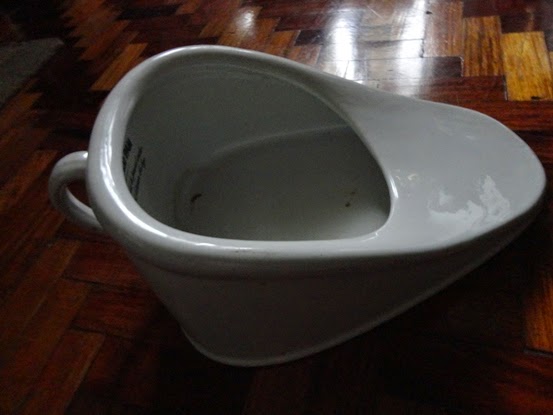
One of the oddest things I found in my scrounging expeditions was this porcelain bedpan, in pristine condition. It is clearly an old piece, and a quick online search yielded a bit of info about this vintage hospital collectible that has the potential to become a "conversation piece".
The slipper bed pan is passed under the patient in front, between the legs, and comes with a handle for easy retrieval.
The British maker, S. Maw Son & Sons, was active from 1860s-75 as a medical instrument manufacturer in London England. The firm was renamed S. Maw, Son and Sons after 1918, which dates this bedpan from 1918-1920s. By 1940, the company evolved into Maws Pharmacy Supplies Ltd., based in Barnet, England. Hospital collectibles are not exactly hot items purused by private collectors--but I'll make an exception this case--as I may someday make use of it!!
Labels:
1910s,
1920s,
antiques,
ceramics,
hospital collectible.,
medical antique,
porcelain
Sunday, December 14, 2014
318. MANILA RAILROAD MILK PITCHER
In the U.S. one hot collectible field is Railroadiana--which refers to artifacts or items of current as well as defunct railways no longer in operation.This very rare specimen-- a small milk pitcher from the Manila Railroad Company is one such example. Passengers were served hot meals and drinks by uniformed railway staff, using tableware--plates, coffee cups, saucers-- bearing the MR logo. This surviving piece from the 30s, was offered by by a Manila collectible shop and it took little convincing for me to acquire it, as it's not only unique, but is also full of history.
The Manila Railroad Company was one of the largest domestic corporations in the Philippines from 1917 -1940's which the Philippine Government acquired in 8 Jan. 1917. Its railway lines totaled 1,140.5 in 1941, located in Luzon. The lines extended from San Fernando, La Union, in the north, to Legaspi, Albay, in the south. The more important branches are the Paniqui-San Quintin, Tarlac-San Jose, Bigaa-Cabanatuan, San Fernando-Carmen, Calamba-Batangas, and College-Pagsanjan. The company was taken over by the U.S. military during World War II, to be used for the defense of the Philippines. The Manila Railroad Co., suffered irreparable losses from which it has never recovered, thus ending its operations.
Labels:
1930s,
antiques,
ceramics,
Filipiniana,
houseware,
Philippines,
railroadiana
Tuesday, December 31, 2013
285. Shadow Boxing: BAMBINO JESUS
Shadow box crafts seemed to be a popular hobby among Filipinos in the 20s and 30s as I have seen countless examples of all sorts---from boxing family portraits embellished with mother-of-pearl flowers, embroidered art, to religious tole art such as this 3-dimensional Bambino Jesus, pasted on a heavy board, then dressed in real cloth and accessorised with handcrafted symbols of his Passion as well as silk flowers. The shadow box dates from 1929--the back was lined with old newspapers dated from that era.
It's been said that these kinds of crafts were introduced by religious educators, evolved from some kind of monastic art that nuns dabbled with in the 19th century. Favorite motifs includ dressing up prints of the sacred Heart of Jesus and Mary, as well as the Holy Family. My Bambino box was purchased in Bulacan. The condition is fair to poor--the flowers are disintegrating, the lithographed cut-out of Jesus is starting to curl. Hopefully, I can have this restored soon! This kind of art is slowly vanishing, but it's never too late to try your hand at this--all you need are deft hands, some artistic skill and lots of imagination!
Labels:
1930s,
antiques,
Bulacan,
collectibles,
Filipiniana,
religious collectibles,
shadow boxes,
vintage
Sunday, December 15, 2013
283. For the Kid Chef: MINI-CLAY KITCHEN TOY UTENSILS
These three miniature clay kitchen utensils are all that's left of a large kitchen play set, made in the Philippines in the 1930s. The first to be a "kendi", an almost-defunct Southeast Asian earthenware--at least in the Philippines--used as a drinking vessel and treasured by early Filipinos as a family heirloom. The next item looks like a clay version of a "tacho", those rund copper cooking pans with handles. The last is a very tiny "mangkok" or bowl. These simple Philippine toys of fired clay were sold in bazaars and tourist shops during the Commonwealth years, popular souvenirs from an American-controlled country finding its identity through its unique traditions in play and children's leisure.
Labels:
1930s,
antiques,
ceramics,
children's toys,
collectibles,
Filipiniana,
playthings,
toy,
vintage
Friday, November 1, 2013
278. BISQUE RIZAL BUST
An unusual Rizal bust made of bisque, an unglazed kind of ceramic, turned up recently for sale in San Fernando, and I quickly snapped it up as an addition to my Rizaliana bust collection. The 8 inch bust clearly identifies the national hero by way of his name etched on the front of the bust. Dating from 1930s, Rizal's likeness is pleasantly captured in this representation--although I find him a bit googly-eyed, don't you think? I've seen wooden Rizal busts, busts made of cast cement and plaster--but not made of bisque, which was a favored material of European casters--French and German doll makers even made doll heads of this not-so-smooth, matte ceramic stuff. I just wonder if there's a Rizal bust out there made of China or porcelain?!
Labels:
1930s,
antiques,
ceramics,
collectibles,
collecting,
Filipiniana,
Pampanga,
Rizaliana,
San Fernando
Tuesday, June 18, 2013
265. A Pressing Issue: COLLECTING OLD FLAT IRONS
I don't know for what reason, but one of my very first antique purchase were these flat irons or "prensa" or "plantsa" made of brass (Php100 in 1985). I think I was attracted to their utilitarian value more than their antiquity, a reminder of the hard work that went into perfect homemaking. Early presses used heat to iron out wrinkles on clothes and fabric--the above example is called "plantsa korona" as it had an open circular top over which live coals were placed. Held by a wooden handle (now gone), the "plantsa" is then made to slide over clothing over and over again, to remove and smoothen out creases. Made of brass, these 'plantsa koronas' were tricky to use, as sparks would fly from the uncovered top and could singe the fabric.
Later plantsas were streamlined in shape, closer to how modern flat irons look like. They were made with a top cover where charchoals could be place into the 'plantsa's" hollow body that had vents to draw off excess heat. "Plantsang de uling", these were called, and these examples are what are usually found in antique shops today. The above 'plantsa' is Philippine made and dates back to the early 50s.
Antique flat irons from the Asian region looked very similar, although many integrated local designs onto the body. This brass example, from Thailand, has incised designs on the rims, and the wooden handle is supported securely with two brass prongs mounted directly on the body of the flat iron. The cost of antique flat irons remain steady in the Philippine antique market with a price range of Php 1500-3000 for the 'plantsa korona', depending on the size. Plantsang de uling could be had for under a thousand bucks. It's all up to you how to display them--I once used my plantsas as book-ends, as a vase holder, or a desk accent to contain paper clips, staples and post-its. You can even use them for their intended purpose, but do learn how not to burn.
Later plantsas were streamlined in shape, closer to how modern flat irons look like. They were made with a top cover where charchoals could be place into the 'plantsa's" hollow body that had vents to draw off excess heat. "Plantsang de uling", these were called, and these examples are what are usually found in antique shops today. The above 'plantsa' is Philippine made and dates back to the early 50s.
Antique flat irons from the Asian region looked very similar, although many integrated local designs onto the body. This brass example, from Thailand, has incised designs on the rims, and the wooden handle is supported securely with two brass prongs mounted directly on the body of the flat iron. The cost of antique flat irons remain steady in the Philippine antique market with a price range of Php 1500-3000 for the 'plantsa korona', depending on the size. Plantsang de uling could be had for under a thousand bucks. It's all up to you how to display them--I once used my plantsas as book-ends, as a vase holder, or a desk accent to contain paper clips, staples and post-its. You can even use them for their intended purpose, but do learn how not to burn.
Labels:
1900s,
antiques,
collectibles,
collecting,
houseware,
Philippines
Tuesday, January 8, 2013
249. Filipiniana Tole Art: A WEDDING IN 3-D
One of the more unusual framed photos I have seen is this three-dimensional photo cut-out of a wedding couple, assembled between glass, found in an Apalit warehouse. The pictures appear in layers, with each picture element--the bouquet, the bride and the groom--cut out and glued on wood; which means that several sets of the same wedding photo were used to make this tole art piece.
The whole ensemble was then mounted on the base of a frame, then sandwiched between glass, and the result is rather a unique and striking presentation of the busts of a wedding couple at a very special moment of their lives.
I have seen only 2 similar pieces in my collecting lifetime--one, a solo figure of a woman in butterfly sleeves, and the other, also a 1930s wedding anniversary picture of a prominent couple in my town:
I may never know the identities of the bride and the groom, but what I do know is that their lifelike good looks are forever preserved in this rare, tole art piece that is a testament to the imaginative creativity of a Pinoy artist-photographer!
The whole ensemble was then mounted on the base of a frame, then sandwiched between glass, and the result is rather a unique and striking presentation of the busts of a wedding couple at a very special moment of their lives.
I have seen only 2 similar pieces in my collecting lifetime--one, a solo figure of a woman in butterfly sleeves, and the other, also a 1930s wedding anniversary picture of a prominent couple in my town:
I may never know the identities of the bride and the groom, but what I do know is that their lifelike good looks are forever preserved in this rare, tole art piece that is a testament to the imaginative creativity of a Pinoy artist-photographer!
Labels:
1930s,
antiques,
Filipiniana,
folk art,
old photos,
painting,
vintage
Wednesday, December 12, 2012
247. I GAT RIZAL'S BUST!
Now here's a nicely-put together cast metal bust of our national hero which I found in a used furniture shop in Apalit. And unlike plaster statues of Jose Rizal, this one is made of heavy polished brass. The base, I suspect, is a later addition, made of wood, aluminum and accentuated with a metal crest. Maybe this once rested on somebody's desk, or in some school principal's or politico's office. But for now, I am happy to house Gat Jose in my library, happy to have a hero watch over me.
Labels:
1950s,
antiques,
collectibles,
collecting,
Filipiniana,
Rizaliana
Monday, November 19, 2012
244. SANICULAS COOKIE MOLDS
The celebrated miraculous bread, known as “panecillos de San Nicolas”, is known simply in Pampanga as “saniculas’. There used to be a ritual blessing of the cookies before they are distributed, although this tradition is now rarely practiced, saved for some Recollect parishes like San Sebastian where saniculas are still blessed during Masses.The cookie itself is made using age-old techniques and ingredients like arrowroot flour (uraro), eggs, lard, dalayap (lemon rind) and coconut milk.
The “saniculas” wooden moulds which are used to impress the dough with the distinctive imprint are interesting kitchen artifacts themselves. They are often commissioned from Betis and Bacolor carvers, and although the designs vary, the moulds always have the abstracted figure of the saint in the center, surrounded by floral, vegetal and curlicue patterns.
Kapampangan cooks treasure these uniquely-designed wooden molds, which commonly came as single blocks. Some have back-to-back designs, but most are often carved with the owner’s initials. As fine examples of folk art, “saniculas” moulds have also found their way in antique shops.
Labels:
1920s,
antiques,
Filipiniana,
houseware,
thrift shop,
woodcarving
Monday, August 27, 2012
235. Holy Finds! RELIGIOUS PRINTS
As a collector of sacred art, I got excited when i saw these very old black and white prints showing religious figures, Biblical scenes and character at an art shop in Devonport, New Zealand. They are rather large prints and seemed to have come from the same book. There were classic representations of the Immaculate Conception, The Scourging of Christ, the Holy Family, The Way of the Cross--and so much more, probably printed in Italy. Some of the scenes are captioned in Spanish, French and English. The curator/shop owner told me they date back to the late 1890s-1900, making them authetic 100 year old antique. She was kind enough too, to give me a special package price for 3 lovely prints. In Manila, these would probably be worth Php 5,000 apiece, as European-made religious prints are hard to come by--last time I saw a black and white Currier & Ives print of Sacred Heart for sale locally was over a decade ago--and that was American-made!
Labels:
1890s,
antiques,
ephemera,
New Zealand,
religious collectibles
Sunday, August 5, 2012
233. CHASING MARIA CLARA
This picture showing a beautiful pair of Filipiniana busts was sent by phone to me for my consideration by my antique dealer from Bulacan. One look and I knew these were very rare pieces--and very old. The almost identical busts show two Filipinas in a typical Maria Clara outfit, characterized by a stiff panuelo, covering their camisa. One of the ladies has her head in a more tilted position and is about half an inch shorter, but both are carved similarly, right down to the hair caught in a bun at the back. There are polychrome traces on these fine softwood carvings.
I agreed with my dealer to see the busts up close on a Friday, as I really don't buy items without first seeing them--especially at the price he wanted. But towards the week, he phoned again to tell me that the middleman peddling the busts was pulling them out from his shop (he was taking them to Manila)--and asked f I could see them before Friday. That proved impossible for me, as I was still at work in Makati, so sadly, I passed them up. But the images of these rare Filipiniana pieces kept haunting me.
Next thing I knew, the pair appeared in an online shop in just a matter of days--sulit.com.ph--advertised by a Manila dealer. I quickly got in contact with the dealer and confirmed that the pair was still up for grabs. There was only one catch though--the original price had doubled! But at that point, i didn't care--the rarity of these pieces told me they were still worth much, much more.
I surmised that these were not commercially sold pieces but commissioned works from some sculptor meant to grace a grand old bahay na bato. Their faces might have even been modelled from real Filipina ladies, sisters perhaps. Another possibility was that these were works of an advanced art student, projects of his sculpting class. The details are impeccable, right down to the turned pedestals and the lacey like edgings of the ladies' panuelo.
But there was one more catch before I could even go check them out at the dealer's place: one bust had been sold. I would have wanted to get the pair, but I was still in luck: since I got to the dealer's place first, I had the first option to choose the bust of my preference. Of course, I picked the taller one, all 23 inches tall, showing a more mature lady of refinement and wealth. So ends my successful chase for this bust that had been the object of my fascination for a week--Maria Clara was mine to keep!
I agreed with my dealer to see the busts up close on a Friday, as I really don't buy items without first seeing them--especially at the price he wanted. But towards the week, he phoned again to tell me that the middleman peddling the busts was pulling them out from his shop (he was taking them to Manila)--and asked f I could see them before Friday. That proved impossible for me, as I was still at work in Makati, so sadly, I passed them up. But the images of these rare Filipiniana pieces kept haunting me.
Next thing I knew, the pair appeared in an online shop in just a matter of days--sulit.com.ph--advertised by a Manila dealer. I quickly got in contact with the dealer and confirmed that the pair was still up for grabs. There was only one catch though--the original price had doubled! But at that point, i didn't care--the rarity of these pieces told me they were still worth much, much more.
I surmised that these were not commercially sold pieces but commissioned works from some sculptor meant to grace a grand old bahay na bato. Their faces might have even been modelled from real Filipina ladies, sisters perhaps. Another possibility was that these were works of an advanced art student, projects of his sculpting class. The details are impeccable, right down to the turned pedestals and the lacey like edgings of the ladies' panuelo.
But there was one more catch before I could even go check them out at the dealer's place: one bust had been sold. I would have wanted to get the pair, but I was still in luck: since I got to the dealer's place first, I had the first option to choose the bust of my preference. Of course, I picked the taller one, all 23 inches tall, showing a more mature lady of refinement and wealth. So ends my successful chase for this bust that had been the object of my fascination for a week--Maria Clara was mine to keep!
Labels:
1910s,
antiques,
decoratives,
Filipiniana,
woodcarving
Sunday, October 2, 2011
202. SHIRLEY TEMPLE CEREAL BOWL & PITCHER
Original cobalt blue cereal bowl and pitcher set with the stamped likeness of 1930s star, Shirley Temple. These were premium items given away by General Mills Cereal that came free with every purchase of Wheaties. A pitcher, cup, and bowl were released. The pitcher is most common and is worth around $35-45, the cup and bowl are more rare and are usually worth around $50 or more. In the 1970s/1980s reproduction Shirley Temple glassware was released to the market but their quality leaves much to be desired. I got these toy tableware from the Greenhills Antique fair, along with the fan photo of an older Shirley Temple.
Labels:
1930s,
antiques,
decoratives,
Greenhills Antique Fair,
houseware,
Shirley Temple,
toy
Thursday, September 22, 2011
194. CHINA HEAD DOLLS
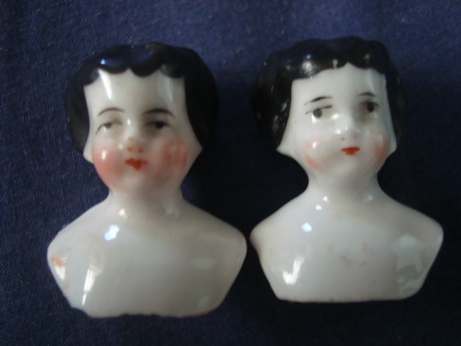
A pair of teensy-weensy china head dolls, no more than 3/4 inch high. They date from 1910-20 and are made in Japan, though the best and finest examples are from Germany. Painted china head dolls also came with separate arms and legs which could be assembled by an adept sewer on a cloth body, then dolled up in the latest fashion. These heads are so small, the dolls would probably measure about 5-6 inches when completed. I found them at Makati Cinema Square (whic sadly, is about to go!) and at the moment, I have no plans though of making cloth bodies for them--they're better off kept and seen in my shadow box, where they wll repose most likely for the rest of their doll lives.
Wednesday, August 31, 2011
190. FOLK ART FRUITS IN SHADOW BOXES
Was lucky enough to find this pretty pair of folk art fruit ensembles in shadow boxes that date back to the pre-War 30s. They used to hang in the home of a dealer-collector, until he probably got tired of them and consigned them at an antique shop. They're not exactly cheap but these fruity displays are very typical Filipiniana pieces that were handcrafted and sold at curio shops in Manila. The fruits are so life-like--they are actually made of wood, pulp and fabric coated with escayola/ gesso then painted realistically and assembled in their narra frames. The first boxed frame features a basket of indigenous fruits like kamatsile, lanzones, balimbing, atis, mabolo, duhat, banana. chico and kasuy, artfully arranged in an embroidered red satin pouch.
The second shadow box combines fruits and vegetable--ampalaya, green and yellow mangos, turnips, squash, guava, sampalok, avocado and a section of a sugar cane. The fruits are wired and stitched on to a fabric backing, which in turn, was nailed onto the wooden stretcher. The molded fruits have some minor scruffs but overall, the unusual displays are in fairly good condition despite their 70 odd years. Who would think that artistic inspirations can also come from our own orchard?
Labels:
1930s,
antiques,
decoratives,
Filipiniana,
folk art,
frames
Wednesday, July 27, 2011
185. PEN AND INK FOLK ART
"Happy Birthday, Pering. 26 July 1916". A heart shaped cut-out in the middle of the rose originally contained the picture of Pering, now lost. The colored paper art included a rustic scene in the foreground.
Labels:
1910s,
1930s,
antiques,
collectibles,
collecting,
ephemera,
Filipiniana,
folk art
Tuesday, November 23, 2010
151. Busted: JOSE RIZAL by Guilermo Tolentino
This particular Rizal bust, which is only about 7 inches high, is numbered at the nape, and possibly dates back to the 1950s. It was offered on ebay but was unsold. The bust is bare cement, without paint, and was made to decorate a desk or a shelf.
Labels:
1950s,
antiques,
Filipiniana,
Philippines
Subscribe to:
Posts (Atom)