Showing posts with label ceramics. Show all posts
Wednesday, January 10, 2018
387. Made in Occupied Japan: ASIAN COUPLE FIGURINES
Made in Occupied Japan collectibles are harder to find these days, moreso a decorative pair as intact as this. "Occupied Japan" was printed on ceramics, pottery,
porcelain, toys, and other goods made during the American occupation of Japan
after World War II, from 1947 to 1952. You can say that today, they were produced in limited number which account for their collectability.
These 4.5. inch porcelain pair with "occupied Japan mark depict an Oriental Couple, but I can't pinpoint which country. Most likely, the costumes are highly-stylized versions of ancient Japanese costumes. Or they could be also composites of Korean and Japanese clothes. In any case, the figurines have very nice colorings, with paint as vibrant as the day they were made. I guess collecting more Occupied Japan pieces will keep me, well, occupied for this year! I love these kinds of vintage kitsch!!
Labels:
Asian,
ceramics,
decoratives,
figurines,
Made in Occupied Japan,
World War II
Friday, February 3, 2017
378. MOPTOP COMBO PLAYER FIGURINES
Now here's a pair of Made in Japan figurines that hark back to the age of the Beatles, Shindig, Dave Clark 5, American Bandstand, the Monkees, and Hullabaloo. The two china figures represent combo players of the 60s era, and may have once graced a teenage girl's room, as she listened to her vinyl records playing the songs of Paul, John, Ringo and George on her plastic turntable. Alas,only two figurines remain--one singing the melody while beating a conga, the other, strumming away on his red electric guitar. The drummer and,possibly, the bass player are missing from the set, but that doe not detract from kischy cuteness of these two boy band members, who even have their original nylon moptop hair! And note the green bases where they stand--complete with musical notes! You could almost hear them belting out.."She loves you yeah...yeah...yeah!".
Labels:
1960s,
ceramics,
china,
decoratives,
figurines,
houseware,
Made in Japan,
music,
porcelain
Sunday, April 3, 2016
364. Dish and That: MINIATURE TOY DISHES
Another pretty set of Made-in-Japan children's toy tableware--consisting of cups, saucers, creamer, and plates. Nicely hand-painted with floral motifs, these loose pieces are individually marked with "JAPAN". The custom of manufacturing small bowls, mugs and plates began in Europe--mainly in England, France and Germany, after 1760. Items were smaller in size than their adult counterparts, though there was no one standard size.In the U.S., toy dishes manufacturing peaked from the 1920s-40s.Japanese companies also produced fine children's dishes around this time--and these examples are from that period. After World War II, inexpensive Japanese imports flooded the market, made of other materials like tin and plastic. Once for playing, wee-size antique children's dishes have become sought-after collectibles, with one set of miniature china going for about $1,000 in a U.S. auction!!!
Labels:
1920s,
ceramics,
children's toys,
Made in Japan,
miniatures,
porcelain
Thursday, September 24, 2015
345. I'm A Little Teapot: 50sTOY TEA SET
I don't remember where I got this complete set of "Made in Japan" toy tea set, with its box intact. Probably from Makati Cinema Square. Since I have so much pet cats, I thought the "kitty tea set" would be a nice addition to my feline collection.
Children's toys such as these were widely available in bazaars everywhere in the Philippines as they were cheaply made. Unfortunately, they were also well-loved and much-played with, that often resulted in broken and missing pieces. That is why, I am lucky to have found this miniature play pieces in unused condition. Maybe one of these days, I'll treat my friends to tea and sconces, using my 50 year old plus tea ware, and hold the nicest tea party in the house.
Labels:
1950s,
ceramics,
children's toys,
collectibles,
Made in Japan,
toy
Monday, May 25, 2015
333. Rising in Value: PHOENIX PLATE
One of my first oriental antiques is this so-called 6.5" diameter Phoenix Plate which I bought in the 80s at the famous Aldevinco Shopping Center in Davao--known for its excavated and salvaged antiques. It shows the legendary bird, hand-drawn in the middle of the plate, flying off in resurrection. Alongside dragons and roosters, the phoenix is a popular theme in Oriental art.
In mytholology, it is a long-lived bird that cyclically reborn--thus the phoenix is associated with the Resurrection of Christ. In Art, it is depicted as a very colorful bird, the size of an eagle with a nimbus to symbolize its association with the Sun.
This particular Phoenix Plate is made of glazed clay; I have no idea as to its age, but it does look and feel very old. I've had this sitting on a shelf for s long, surviving typhoons and earthquakes from the last three decades. I am not worried it might break because for sure--like the mythical phoenix--it will become whole and rise again!
In mytholology, it is a long-lived bird that cyclically reborn--thus the phoenix is associated with the Resurrection of Christ. In Art, it is depicted as a very colorful bird, the size of an eagle with a nimbus to symbolize its association with the Sun.
This particular Phoenix Plate is made of glazed clay; I have no idea as to its age, but it does look and feel very old. I've had this sitting on a shelf for s long, surviving typhoons and earthquakes from the last three decades. I am not worried it might break because for sure--like the mythical phoenix--it will become whole and rise again!
Labels:
Aldevinco Davao,
antiques,
ceramics,
collecting,
Filipiniana,
Orientalia,
porcelain,
pottery
Sunday, January 11, 2015
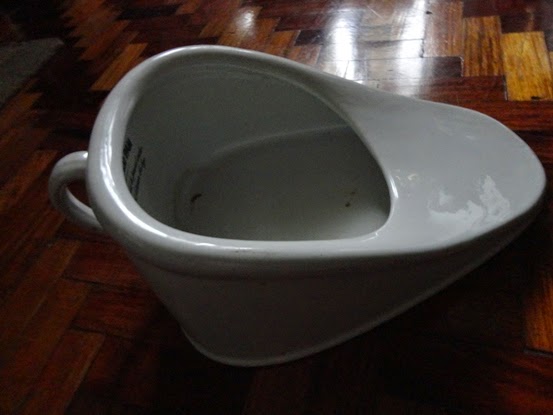
321. Nurse, I Need To Go!: PORCELAIN BEDPAN
One of the oddest things I found in my scrounging expeditions was this porcelain bedpan, in pristine condition. It is clearly an old piece, and a quick online search yielded a bit of info about this vintage hospital collectible that has the potential to become a "conversation piece".
The slipper bed pan is passed under the patient in front, between the legs, and comes with a handle for easy retrieval.
The British maker, S. Maw Son & Sons, was active from 1860s-75 as a medical instrument manufacturer in London England. The firm was renamed S. Maw, Son and Sons after 1918, which dates this bedpan from 1918-1920s. By 1940, the company evolved into Maws Pharmacy Supplies Ltd., based in Barnet, England. Hospital collectibles are not exactly hot items purused by private collectors--but I'll make an exception this case--as I may someday make use of it!!
Labels:
1910s,
1920s,
antiques,
ceramics,
hospital collectible.,
medical antique,
porcelain
Sunday, December 14, 2014
318. MANILA RAILROAD MILK PITCHER
In the U.S. one hot collectible field is Railroadiana--which refers to artifacts or items of current as well as defunct railways no longer in operation.This very rare specimen-- a small milk pitcher from the Manila Railroad Company is one such example. Passengers were served hot meals and drinks by uniformed railway staff, using tableware--plates, coffee cups, saucers-- bearing the MR logo. This surviving piece from the 30s, was offered by by a Manila collectible shop and it took little convincing for me to acquire it, as it's not only unique, but is also full of history.
The Manila Railroad Company was one of the largest domestic corporations in the Philippines from 1917 -1940's which the Philippine Government acquired in 8 Jan. 1917. Its railway lines totaled 1,140.5 in 1941, located in Luzon. The lines extended from San Fernando, La Union, in the north, to Legaspi, Albay, in the south. The more important branches are the Paniqui-San Quintin, Tarlac-San Jose, Bigaa-Cabanatuan, San Fernando-Carmen, Calamba-Batangas, and College-Pagsanjan. The company was taken over by the U.S. military during World War II, to be used for the defense of the Philippines. The Manila Railroad Co., suffered irreparable losses from which it has never recovered, thus ending its operations.
Labels:
1930s,
antiques,
ceramics,
Filipiniana,
houseware,
Philippines,
railroadiana
Saturday, October 11, 2014
312. YOU'RE A KEWPIE DOLL!
"Cute as a Kewpie!"
Kewpies were initially conceived as comic strip characters by artist, Rose O'Neill. The name "Kewpie" it is said, was derived from "Cupid"-- also depicted in mythology as a youn child, naked and winged. The cartoons began to gain popularity after the publication of O'Neill's comic strips in 1909, and thereafter, paper doll versions of the Kewpies were made. The characters were first produced as bisque dolls in Germany beginning in 1912, and became extremely popular in the early twentieth century.Later, they were made from composition, celluloid, hard plastic, soft rubber and vinyl.
The earlier bisque and composition versions of Kewpie dolls are widely sought-after by collectors--and this 7-inch German-made example was a prize find from a local antique shop. Versions were made without the identifying Kewpie heart label found on the doll's chest, but all have the same characteristics: protruding belly, googlie eyes, stubby arms and little back wings. Kewpies have become part of our pop culture--used as mascots, in advertising, art, and even in songs!
Kewpies were initially conceived as comic strip characters by artist, Rose O'Neill. The name "Kewpie" it is said, was derived from "Cupid"-- also depicted in mythology as a youn child, naked and winged. The cartoons began to gain popularity after the publication of O'Neill's comic strips in 1909, and thereafter, paper doll versions of the Kewpies were made. The characters were first produced as bisque dolls in Germany beginning in 1912, and became extremely popular in the early twentieth century.Later, they were made from composition, celluloid, hard plastic, soft rubber and vinyl.
KEWPIES made in Germany. With and without the identifying Kewpie heart label. PICTURE SOURCE:http://en.wikipedia.org/wiki/Kewpie
The earlier bisque and composition versions of Kewpie dolls are widely sought-after by collectors--and this 7-inch German-made example was a prize find from a local antique shop. Versions were made without the identifying Kewpie heart label found on the doll's chest, but all have the same characteristics: protruding belly, googlie eyes, stubby arms and little back wings. Kewpies have become part of our pop culture--used as mascots, in advertising, art, and even in songs!
Labels:
1910s,
ceramics,
character doll,
children's toys,
collectibles,
collecting,
doll,
playthings
Sunday, April 6, 2014
295. Toby or Not To Be: JESTER CHARACTER CUP
I couldn't help but stare back at this character mug when I chanced upon it at a Makati thrift shop. Fairly small, with some crazing, it looked definitely old, reminiscent of the toby mugs of yore depicting a character in history. Technically, a toby jug depicts a whole person, while a character jug shows just the face, but these ceramic creations share one thing in common--they are all highly collectible!
This example is unmarked--Royal Doulton currently makes the most desirable toby cups and jugs--but the finish of this face jug is superb, the colors vivid and appealing. So off it went to my collection of kitschy ceramics, that includes dozens of lady head vases. I'll probably use this cup, so every time I drink my coffee, I can face-off with this cool, jester dude from the 50s!!
Labels:
1950s,
ceramics,
character cup,
collectible,
collectibles,
decoratives,
figurines,
kitchen collectible
Wednesday, March 26, 2014
294. MOD PIXIE PAIR
I couldn't help but be charmed by the sight of this pair of mod porcelain couple. They definitely exude a genuine 1960s vibe--from the pixie (or Twiggy) haircut of the girl to the fashionable Carnaby outfit of the cross-legged dandy. I assume that these are cake toppers, although they have separate bases. Too bad I have no use for this winsome vintage pair, when everything was mad about mod!
Labels:
1960s,
ceramics,
decoratives,
kitsch,
Made in Japan,
wedding cake topper
Sunday, January 19, 2014
288. BUDDHA INCENSE HOLDER
Now here's a small Buddha incense holder made from delicate porcelain. It is another one of those Made in Japan pieces and probably dates back to the 50s. Incense sticks were stuck behind the figure and the ashes were collected in the opening at the back--now that's neat!
Religious figures often inspire artisans to come up with objects for domestic use. I have seen the Blessed Virgin converted into a bottle, a Jesus planter, and a Saint Joseph night lamp. I guess this incense holder is more appropriate to Buddha. In any case, I like the nostalgia this piece evoked, and the bright, vivid colors add to the appeal. It sits on my desk now, not as an incense holder but as a receptacle for my paper clips, a reminder to keep calm and work, work, work!!
Labels:
1960s,
ceramics,
collecting,
Made in Japan,
religious collectibles,
vintage
Wednesday, January 8, 2014
286. BISQUE KIDS
Found this trio of bisque figures of kids--two girls in winter outfits and a little softballer. The heads are movable.. I'm almost sure they were made in Japan for the export market--I see these a lot in glass cabinets of many ancestral homes. No more than 3 inches tall, these adorable figurines sit perfectly on a wooden shadow box...not too precious, but still as decorative as they were made over 80 years ago!
Labels:
1920s,
1930s,
ceramics,
collectible,
decoratives,
Made in Japan
Sunday, December 15, 2013
283. For the Kid Chef: MINI-CLAY KITCHEN TOY UTENSILS
These three miniature clay kitchen utensils are all that's left of a large kitchen play set, made in the Philippines in the 1930s. The first to be a "kendi", an almost-defunct Southeast Asian earthenware--at least in the Philippines--used as a drinking vessel and treasured by early Filipinos as a family heirloom. The next item looks like a clay version of a "tacho", those rund copper cooking pans with handles. The last is a very tiny "mangkok" or bowl. These simple Philippine toys of fired clay were sold in bazaars and tourist shops during the Commonwealth years, popular souvenirs from an American-controlled country finding its identity through its unique traditions in play and children's leisure.
Labels:
1930s,
antiques,
ceramics,
children's toys,
collectibles,
Filipiniana,
playthings,
toy,
vintage
Sunday, November 24, 2013
281. A Tisket, A Tasket: MINI-CLAY BASKET OF FRUITS
Very few native toys were made commercially in the Philippines--and the early ones made meant to prepare little girls for their future roles in their hearth and homes: mini-kitchen wares, mini-flat irons, mini-stoves, mini-wash basins, mini-everything!
This 50s clay basket of fruits was one such plaything made--fashioned from clay, the only viable material that was readily available in provinces. Probably, this was part of a set of collectible clay wares peddled in the local market, or sold in front of churches--where people congregated. Other clay products that catered to kids included piggy banks, which continue to be produced today. But these clay playthings of fruits and basket have all but vanished from the neighborhood tiangges (markets), the same way that kids have disappeared from the streets, to play computer games instead in the privacy of their homes.
Labels:
1950s,
ceramics,
children's toys,
collectibles,
collecting,
Filipiniana,
playthings,
toy,
vintage
Friday, November 1, 2013
278. BISQUE RIZAL BUST
An unusual Rizal bust made of bisque, an unglazed kind of ceramic, turned up recently for sale in San Fernando, and I quickly snapped it up as an addition to my Rizaliana bust collection. The 8 inch bust clearly identifies the national hero by way of his name etched on the front of the bust. Dating from 1930s, Rizal's likeness is pleasantly captured in this representation--although I find him a bit googly-eyed, don't you think? I've seen wooden Rizal busts, busts made of cast cement and plaster--but not made of bisque, which was a favored material of European casters--French and German doll makers even made doll heads of this not-so-smooth, matte ceramic stuff. I just wonder if there's a Rizal bust out there made of China or porcelain?!
Labels:
1930s,
antiques,
ceramics,
collectibles,
collecting,
Filipiniana,
Pampanga,
Rizaliana,
San Fernando
Sunday, June 30, 2013
266. Sulit Kitsch: 50s LADY HEAD BUSTS
Don't you just love sulit.com.ph? The country's biggest online sell-trade-buy marketplace has the widest, weirdest, funkiest assortment of goodies any collector would go crazy for. One of my most recent unexpected finds is this pair of small busts, made of plaster, representing 2 fashionable ladies from the 50s. All of 6 inches tall, they realistically represent the midecentury look gal--from the puffed hairdo, to their mod, stylish clothes.
The first lady head bust looks almost Oriental, with rosy cheeks, red lips and puffed up hair held with a green bandanna tied in a knot under her chin. She wears a green blazer with padded shoulders, over a cream colored blouse, a style so much in vogue in the war and early post-war years.
The second lady wears a more daring outfit, with a plunging neckline, accessorized by a flower on her puff-swept hair. With her heavy make up, she looks like she's ready to paint the town red!
The back of the plaster busts are incised with what looked like scripts in gibberish, but upon closer examination, I recognized them as Burmese letters--which I can't read anyway. Maybe these ladies represent important women from Burma--actresses maybe, but Ican't be sure. What I am certain is that this kitschy pair are worthy collectibles, flash from the 50s golden period of Hollywood glamor and style.
The first lady head bust looks almost Oriental, with rosy cheeks, red lips and puffed up hair held with a green bandanna tied in a knot under her chin. She wears a green blazer with padded shoulders, over a cream colored blouse, a style so much in vogue in the war and early post-war years.
The second lady wears a more daring outfit, with a plunging neckline, accessorized by a flower on her puff-swept hair. With her heavy make up, she looks like she's ready to paint the town red!
The back of the plaster busts are incised with what looked like scripts in gibberish, but upon closer examination, I recognized them as Burmese letters--which I can't read anyway. Maybe these ladies represent important women from Burma--actresses maybe, but Ican't be sure. What I am certain is that this kitschy pair are worthy collectibles, flash from the 50s golden period of Hollywood glamor and style.
Labels:
1950s,
ceramics,
collectible,
collecting,
decoratives,
houseware,
kitsch,
online shops,
pop culture,
vintage
Wednesday, February 13, 2013
253. HULA-BALOO!
When Hawaii became America's newest state in 1959, its native culture fascinated American mainlanders--including its sinuous dance--the "hula". Inspired by dancing "Leilanis" , many merchandisers cashed in onthis iconic image of a hip-swaying Hawaiian maiden in a (missing) grass skirt and came up with nodders and bobbers meant for car dashboards and curio cabinets. This Made-in-Japan example, straight from the 50s, falls into that category, but is much more functional. For one, the figurine is a bobber and ash tray in one, and is made of more expensive ceramic than the usual plaster cast models. The upper body is attached to its lower part with a spring. When shaken, the figure wobbles, mimicking the swaying moves of graceful hula dancers. So kitschy...so tacky...so collectible!!
Labels:
1950s,
action figure,
ceramics,
decoratives,
kitsch,
Made in Japan
Sunday, September 23, 2012
238. CHOCOLATE DEMISTASSE CUPS
I remember my Grandmother Patricia's (Apung Tiri) old and tiny demitasse cups which my Mother kept for the longest time in an old bookcase that had lost its glass panelled doors. In fact, she used that bookcase to store her special crockery, to be taken out and used only during special occasions like our annual fiestas. Same was true for Apu’s lovely little cups—they were only taken out once or twice a year. By any standards, her demitasse cups were just plain white ironstone cups, not even porcelain—with a raised relief of a carnation flower in front.
These cups were used to serve special hot chocolate, freshly made from ground chocolate mixed with peanuts and gatas damulag, then briskly whisked in a brass chocolatera using a wooden batirul. The resulting frothy chocolate drink was sipped daintily from these cups, to be savored slowly, with puto, broas or çhurros, depending on your taste and budget.
Sometimes on Christmas, we also filled these cups with green duman (gelatinous rice) and then pour the hot chocolate afterwards—a taste treat unlike any other! My Mother too had her own sets of demitasse cups which she recived as wedding gifts—she had real porcelain cups with transfer print of roses as well as even smaller ones with gilt rims. So treasured were these cups that they were even etched on the bottom with my mom’s initials—E.R.C. Through the years though, we lost a lot of these cups; we only have half a dozen now, some without handles, others with cracks. Even then, I keep them on display on a shelf in our old house, a family souvenir of sorts.
Recently, I came upon a nice set of demitasse cups of similar make from two different sources—one from a San Fernando dealer and the other from a roadside Bulacan antique shop. I bought them years apart, so I suppose these cup styles were rather popular. But what makes them special was that they were personalized either with the names of the owners or with personal wishes intended for guests. One example has the name ”Apolinaria” written in a flourish in gold. Others carry greetings like “Amistad”(Amity or Friendship) and “Recuerdo” (Souvenir), in low-grade gold.
These were done by itinerant artisans who once roamed towns offering their unique services of personalizing utensils, jewelry pieces and objects of value by hand. There are those who carefully incised the back of plates and cups with the owner’s initials using a hammer and a metal pick. Others used their calligraphic skills, writing names using gilt paint, as in these examples.
I was lucky to get ten perfect cups—each a showcase of the vanishing art of personalizing objects by hand, as well as memory pieces to remind me of my Apu I never met, and my late Mom’s cooking skills which I continue to miss every day.
Labels:
1930s,
ceramics,
Filipiniana,
houseware,
souvenir
Tuesday, January 3, 2012
210. FIGURAL GOOGLIE CREAMER
I found this googlie-eyed creamer staring at me in an antique shop in Devonport, New Zealand, a charming, seaside resort in Auckland. Figural creamers have been around for so long and most are in the shape of cows, people heads and other animals. This one though, is quite a character. I did a bit of research but found nothing of this houseware collectible that definitely dates from the 1950s. For some reason, it reminded me of a man-in-the-moon or one of those nursery rhyme characters--Humpty Dumpty perhaps. Maybe it was part of a set or a premium giveaway from a now-extinct product. I thought I paid a bit too much for this creamer (30NZ$, or close to a thousand bucks), but then I'd be whacking my head now if I hadn't gotten it. I am sure I will be staring back at this googlie creamer each time I drink my coffee, amused by the thought that I will be as wide-eyed as him in the morning!!
Labels:
1950s,
ceramics,
collectibles,
collecting,
decoratives,
houseware,
kitsch,
New Zealand,
vintage
Monday, September 26, 2011
199. PINCUSHIONS OF THE WORLD
Here's a parade of international chalkware beauties meant to appeal to domesticated moms who loved sewing. These figural pincushions--representing such nationalities as Indian, Chinese, Scot, etc--date from the early 60s; each bust is topped with a flannel-covered cushion where one can stick pins and needles. Cheaply made in Japan, they are nonetheless, brimming with colorful cuteness, especially when lined up on the shelf, don't you think? I just wish they made a Philippine version--a girl with a pot on her head that doubles as a pincushion would have been appropriate!
Labels:
1960s,
ceramics,
decoratives,
kitsch,
thrift shop,
vintage
Subscribe to:
Posts (Atom)