Showing posts with label Filipiniana. Show all posts

Monday, November 6, 2017

383. 50s VINTAGE POMADE BOTTLES: Secrets of our Debonair Dads!

Now here's a trio of small,clear glass jars that once held pomade and solid brilliantine--grooming essentials for the 1950s man. The brands include Cashmere Bouquet, an imported brand; Atomic Solid Brilliantine, and Waling-Waling, both local products. The 50 to 60 year old pomade bottles retain both their tin caps and labels with bold, colorful graphics. The more familiar brand--Cashmere Bouquet--actually has a talcum powder counterpart, while the two are largely unheard-of. More well-known pomade brands of the 50s include Glo-Co, X-7,  and Robin Hood, The small jars were easily disposed of after use, that is why it is amazing to find these 3 pomade jars still in great condition after all these years.

Monday, September 12, 2016

372. Politics is a Game: 1965 MACAPAGAL-ROXAS CHECKER BOARD

An artifact from the national elections of 1965 is this lawanit checkerboard game, given away by the Liberal Party--headed by the re-electionist President Diosdado p. Macapagal and his VP bet, Gerry Roxas, father of presidential wannabe, Mar Roxas. This well-worn political memorabilia also features the party's senatorial slate--Ramon Bagatsing, Cesar Climaco, Ramon Diaz, Sergio Osmena Jr., Alejandro Roces, Jovito Salonga, and Lucas Paredes, The party was no match to the up and coming former Senate president Ferdinand Marcos and team mate Fernando Lopez, who trounced them convincingly at the polls. Only 2 of the LP best got senatorial seats too. Marcos would stay in power for over 2 decades and for his opponents--it was back to the gameboard!

Sunday, February 7, 2016

357. Igorot Art: MAN ON A CARABAO

There was a time that it was fashionable for every home to have a woodcarved souvenir from the northern highlands. Baguio in the 1930s had many homegrown shops that sold carved figures of wood, created by skilled, yet self-taught Igorot natives.
The best-sellers were the ubiquitous giant spoon and fork that hanged on dining room walls. Then, there were also the ethnic tribal busts, always carved in pair--an Igorot and an Igorota--hewn from medium and heavy wood. The spear-wielding full body carving of an Igorot headhunter holding the head of his dismembered victim, was also a favorite piece.This 1950s figure, showing a man astride a carabao,  is less commonly seen. It almost looks like a lowland Filipiniana piece, until one sees the rider dressed in loin-cloth, clearly a mountain man from Igorotlandia.
It is a meticulously crafted piece--from the facial detailing of the man with his saucer-bowl haircut, to the carabao's furry hide, accomplished  by scratching the body with thousands of shallow knife marks. Mid-century decorative pieces such as this have started appearing in antique stores, as more traditional ethnic carvings such become scarcer. They are still plentiful and cheap--but look for the ones made of heavy wood and with characteristic minute detailing. Commercial figural vintage Igorot carvings are the new "bulols"!

Friday, January 1, 2016

353. PRES. QUIRINO'S HAPPY PHILIPPINES POSTER

Now here's a poster to drum up the accomplishments of Pres. Elpidio Quirino--the country's father from 1948-1953, beating Roxas in the elections. His battlecry was 'HAPPY PHILIPPINES" and features major accomplishments as the construction of Ambuklao Dam and the Maria Cristina Hydroelectric Power Plant.I got this poster years ago from the old Plaridel Printing Press in Malolos, Bulacan which is hitoric in itslef as it published many patriotic and nationalistic materials. Quirino's legacy is being hailed as the new Philippine ideology at this crucial time when the country is fighting the elimination of corrupt politicians and the practice of political patronage.

Tuesday, November 10, 2015

350. Advertique: RUFINA PATIS PROMO PLATE

First time to see this one-of-a-kid china dinner plate that was a giveaway of Rufina Patis, the first fish sauce brand in the Philippines founded by widow Rufina Salao vda. de Lucas. The home industry that she put up in 1900 became a successful multi-million peso business, peaking in the 50s and 60s.
The business grew by leaps and bounds after the war and 2 modern manufacturing and bottling plants were erected in 1957 and 168 to meet the growing lucrative U.S.-Filipino market. The company also invested in advertising and in sales promotions--and these collectible plate premiums were among those used to entice housewives to buy a bottle of Rufina Patis.
 This small 8 in.diamter plate bears the Rufina Patis Especial logo and bears the Three Starbest China - Made in Japan manufacturer's mark. It was found on ebay Philippines, sold to me by an old gentleman whose father used to have a general merchandise store selling groceries, including condiments and bottled products.
 On the center of the plate is a delicately colored illustration of a woman in patadyong and salakot, with a basketfull of fish in one arm-- a charming Filipiniana touch on a Japan-made plate.
The piece dates from the 50s and still retains its vibrant colors after all these years. It may not have been used and was used for decorative purposes. This is the first and only known premium item associated with the pioneer patis brand in the country.

Wednesday, October 21, 2015

348. MUNTING CHERUBIMS: Winged Antique Fragments

Picked these pair of wooden cherubims for free--they're just, well, angelic! They're probably parts of an antique santo peana (base for a saint's statue) that were detached, due to age and time, not too old, maybe just 30-40 years old. Even then, they're quite well-made, with many little details like their pudgy cheeks and curly curls. They even retain their original gold paint--although one has been painted over, recently. Right now, they have been repurposed as Christmas tree ornaments, lending an old-world charm to my holiday decorations!

Sunday, October 11, 2015

347. Advertique: ROYAL TRU-ORANGE SIGNBOARD

Now here's a great advertising sign that's truly Pinoy--a wooden signboard for Royal Tru-Orange that dates from the 60s. Royal Tru-Orange was originally formulated and sold commercially in 1922 by San Miguel Brewery before it was eventually bought by Coca-Cola. The brand name is silkscreened in bold colors on a lawanit (pressed wood pulp) board that was a cheaper alternative than conventional tin. This must have been for indoor use--say, a canteen or a large grocery store--as lawanit is not water-proofed.
Some of the memorable campaigns of Royal Tru-Orange emerged from the 1960s and 70s--harping on the natural ingredients of the popular orange soda drink: "Kitang-kita ang ebidensya---'yung may pulp bits syempre!" (You can see the evidence--the one with real orange pulp bits). The 70s gave us "Come Taste and Love It" and in the 80s, the "Royal--Natural, Ganito Talaga ang Buhay!" campaign starring RJ Ledesma, all done by McCann Erickson.

Saturday, June 20, 2015

336. TUMBLING CLOWN ACROBATS

Look at these "Tumbling Clown" plastic acrobat mechanical toys that I found with original box intact. Dating from the 60s, they were made by a plastic toy firm in Malabon--proudly Philippine made!
The pieces are surprising intact after all these years, save for a missing plastic tab or two. The assembly is very simple--one had to snap together the plastic framework pieces to form a sort of a tower. 
Then, all you had to do was set the clowns--which were connected together with a see-saw-like crosspiece--on the topmost ramp of the tower. A little nudge will cause the clowns to "tumble" down in a teeter-totter motion, complete with a jingle-jangle sound--no batteries, no electricity needed! Just plain, simple fun! Just the way childhood should be!
Now, let me do that again....

Wednesday, June 10, 2015

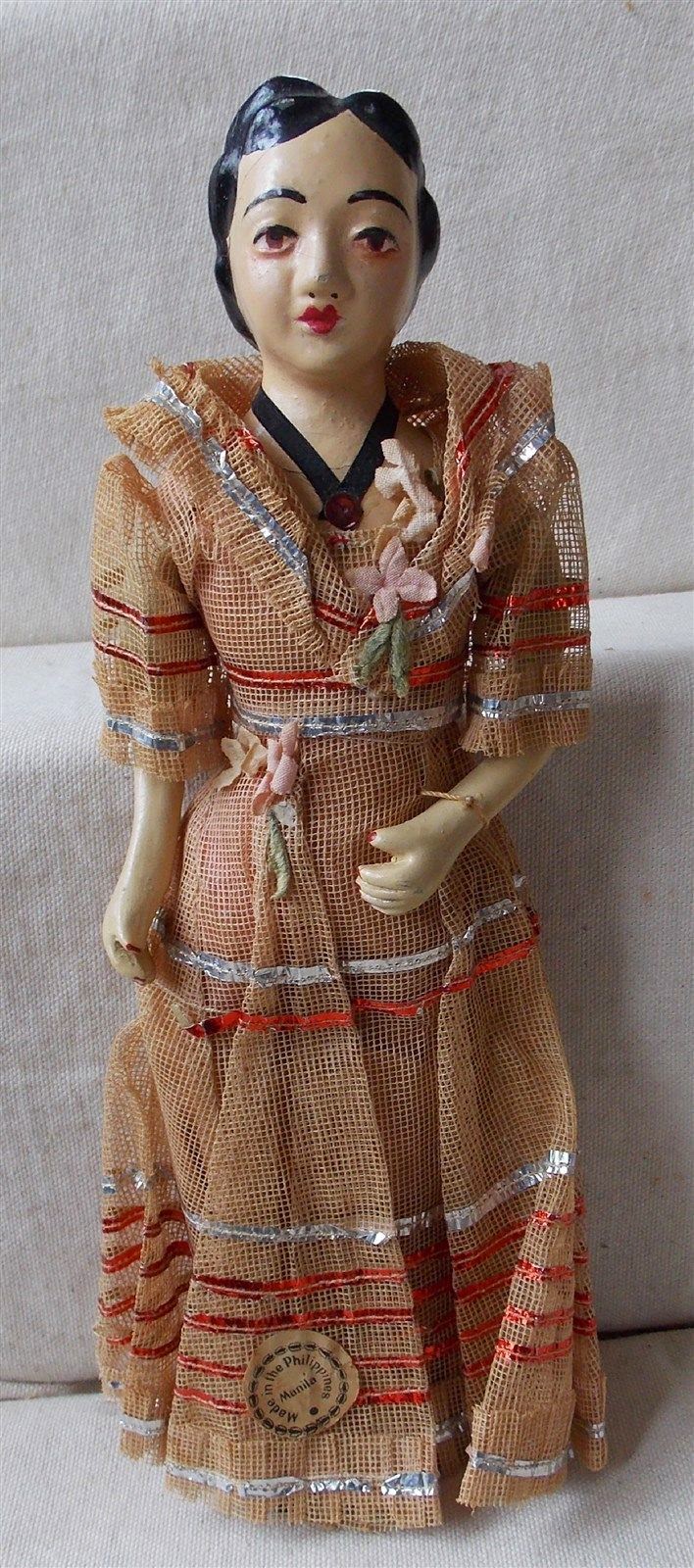
335. Among My Souvenirs: VINTAGE FILIPINA DOLL

In the 1930s--our peacetime era--tourism in the Philippines boomed. many bazaars and curio shops mushroomed in the Malate area, selling Philippine-made souvenirs to domestic and international tourist. Capiz shells, abaca products, woodcarvings, buri hats, banig (mats) and woven jusi and pina fiber were top sellers. For kids,there were a few options--yoyos and pull toys (calesas) for the boys, and for the girls--  Philippine-made dolls of composition with cloth bodies attired in baro't saya, like this example, in very good condition.
These were most likely outsourced from contractors who made these at home, products of Philippine cottage industry. They are very fragile, as the composition tend to crack over time, but this charming doll has retained its color, its dress and even its label. She is dressed in a stiffened abaca skirt and top, with a panuelo to complete her 'dalagang bukid' look.
These vintage Philippine dolls occasionally are seen on ebay--like this small 11 inch creation. Thank heavens, they are not that expensive and demand is not too high, so they are very much affordable. Much rarer are bigger dolls of over  a foot in length, made in the same fashion, but with heads of painted clay and more elaborate costumes. Dolls using raw Philippine materials are not just nostalgic souvenirs of childhood but wonderful examples of Philippine folk art.

Monday, May 25, 2015

333. Rising in Value: PHOENIX PLATE

One of my first oriental antiques is this so-called 6.5" diameter Phoenix Plate which I bought in the 80s at the famous Aldevinco Shopping Center in Davao--known for its excavated and salvaged antiques. It shows the legendary bird, hand-drawn in the middle of the plate, flying off in resurrection. Alongside dragons and roosters, the phoenix is a popular theme in Oriental art.
In mytholology, it is a long-lived bird that cyclically reborn--thus the phoenix is associated with the Resurrection of Christ. In Art, it is depicted as a very colorful bird, the size of an eagle with a nimbus to symbolize its association with the Sun.
This particular Phoenix Plate is made of glazed clay; I have no idea as to its age, but it does look and feel very old. I've had this sitting on a shelf for s long, surviving typhoons and earthquakes from the last three decades. I am not worried it might break because for sure--like the mythical phoenix--it will become whole and rise again!

Wednesday, May 20, 2015

332. Advertiques: PHILLIPS PETROLEUM 66

Loyalty has its privileges, indeed. I bought a few items from an antique dealer recently and he gave me this freebie--a  rather large wooden sign of Phillips Petroleum 66. The energy company was founded  by Lee Eldas "L.E." Phillips and Frank Phillips of Oklahoma in 1917.
A shield logo was created in 1930 for its link to the famous highway of the same number, with a black and orange color scheme that would last nearly 30 years. In 1959, Phillips introduced a revised version of the shield in red, white and black, a color scheme still used by Phillips 66 Co. for the brand. Vintage Phillips signs are highly collectible and many reproductions exist. This wooden sign is definitely a local fantasy version, with cut-out letters and carved background (there's a missing piece below). It must have hanged in a private bar or used to decorate a den or a man-cave. I haven't gotten around to restoring it--it is just stashed away in my garage-- to remind me that once upon a time, petrol was so cheap, that everyone on Route 66 was screaming--"Step on the gas!".

Saturday, May 9, 2015

331. Grind, Grind: HEIRLOOM STONE GILINGAN

 Before you start picking for antiques, why not try looking around your own house first? This is just what I did when I started getting hooked on old things. Ever since I can remember, we've always had this stone grinder at home, which was actually used for years in the making of bibingka, tamales and other sweet kakanins (homemade delicacies).
One used a spoon to "feed" the stone grinder with gelatinous rice and water, through a small opening on the top stone wheel. The brass handle is then turned by hand, and the ground rice then comes out of the spout, with a sticky consistency now called "galapung"--the main ingredient in many Filipino sweet treats. This domestic antique bears the name of the original owner, who happens to be the elder brother of my grandpa--Dr. Melecio R. Castro,
The date is carved out on the top stonewheel--Enero 15, 1913--which makes this gilingan a certified antique--over 100 years old! I am glad I saved our stne grinder, which went out of commission many years ago, with the advent of instant "galapung" flour. It still is in great condition, with its original brass turner, that is connected to the stone with a tongue or hardwood, It rests now in my garage, treated like a sculptural piece, the way gilingans are being collected these days as garden ornaments. Hopefully, I will find the opportunity to use this again, to make my favorite tamales. Giling-giling, pag may time!

Thursday, December 25, 2014

319. FILIPINIANA TRINKET BOX

Now here's a tiny trinket box--with dimensions of just  4 in. x 6 in. x 2.5 in.--made of narra, decorated with a relief carving of a farmer taking rest under a mango tree from his day's toil. Across the dirst road stands his nipa hut, shaded by a coconut tree, and flanked by a haystack. Looming in the horizon is a mountain. Souvenir carvings bearing Filipiniana motifs such as this were much in demand by tourists--and this box was especially made to cater to such market. Handicraft centers in Manila, as well as in Pampanga (for the U.S. market ) thrived till the 70s--offering similar items as monkeypod carvings, wall plaques (featuring farmers, dancers), ethnic busts, carved Filipinana chests (our versions of camphor chests) as well as lazy Susans. Today, a few shops exists, selling cottage industry products along the streets of Ermita, and in Angeles City, Pampanga--but the quality has really matched those made in the 50s, when even small items such as this trinket box, were handcarved with fine details, and finished so handsomely.

Sunday, December 14, 2014

318. MANILA RAILROAD MILK PITCHER

In the U.S. one hot collectible field is Railroadiana--which refers to artifacts or items of current as well as defunct railways no longer in operation.This very rare specimen-- a small milk pitcher from the Manila Railroad Company is one such example. Passengers were served hot meals and drinks by uniformed railway staff, using tableware--plates, coffee cups, saucers-- bearing the MR logo. This surviving piece from the 30s, was offered by by a Manila collectible shop and it took little convincing for me to acquire it, as it's not only unique, but is also full of history.

The Manila Railroad Company was one of the largest domestic corporations in the Philippines from 1917 -1940's which the Philippine Government acquired in 8 Jan. 1917. Its railway lines totaled 1,140.5 in 1941, located in Luzon.  The lines extended from San Fernando, La Union, in the north, to Legaspi, Albay, in the south. The more important branches are the Paniqui-San Quintin, Tarlac-San Jose, Bigaa-Cabanatuan, San Fernando-Carmen, Calamba-Batangas, and College-Pagsanjan. The company was taken over by the U.S. military during World War II, to be used for the defense of the Philippines. The Manila Railroad Co., suffered irreparable losses from which it has never recovered, thus ending its operations.

Thursday, December 4, 2014

317. Advertique: MANILA CORDAGE TIN SIGN

Time was when the Philippines was the largest exporter of Manila rope, made of abaca hemp. The country became world-famous for this prized product and one of the first companies to establish a rope business was the Manila Cordage Company which started as a subsidiary of Tubbs Cordage Company of San Francisco on February 20, 1924, Manila Cordage Company, a subsidiary of Tubbs Cordage Company of San Francisco, began operations at the junction of Cristobal and Otis streets in Paco, which had easy access to the Pasig. Its basic raw material was abaca, also known as Manila hemp, which by then was a much sought after commodity in North America.
It  began operations at the junction of Cristobal and Otis streets in Paco, which had an easy access to the Pasig River. Manila Cordage made ropes of all sorts from abaca, which was to be known worldwide as Manila hemp, a much sought after commodity in North America in the 20s-50s decades.
As the company grew, Manila Cordage marketing became more sophisticated, and by the early 50s, it produced merchandising materials and selling aids such as this tin sign that featured a range of products with their special specifications and dimensions. Signs such as this were given to hardware shops and provincial distributors (in this case, J. Rodriguez of Cagayan) to facilite the ordering of the products. It measures 10 in. x 22 in, and is backed by a thick cardboard. 
The invention of synthetic ropes put a dent on the Manila rope business, but the products remained important as they are eco-friendly, and they are specially required by certain businesses like oil drilling and construction. To this day, the Manila Cordage Co. is still a flourishing business with its facilities located in a world-class industrial hub ensuring a future for the rope that made Manila famous!

Thursday, November 13, 2014

316. LAPU-LAPU AND BULAKNA PORTRAITS

A pair of Filipiniana paintings depicting Lapu-Lapu, the hero of Mactan and his wife, Bulakna--or so that's how the dealer described them to me. These mid-century 18 x 22" paintings, painted by artist Rodolfo Pasno, dates from 1957--and they were obtained online--in a facebook group, of all places. Pasno was a noted Mabini painter, active from the 50s thru the 70s, in a shop at the famed Pistang Pilipino.
They were sold in stretchers, with few chips and scratches. At some point, someone painted over the background, but that doesn't detract from the portraits that express so much of the character of the country's first hero and his voluptuous wife. I had them re-stretched, re-framed and cleaned, so now they're ready to hang again...so happy I could sing! "In March 16, fifteen hundred and  hundred twenty one, when Philippines was discovered by Magellan..."

Thursday, October 16, 2014

313. Advertique: AN ABOGADO'S TRADE SIGN

There was a time when it was popular to advertise your professional services via signboards often posted on the front of your residences for all the world to see your title and your degree--from Comadrona, Dentista, Medico to Abogado or Notario Publico. Of course, services are advertised more conveniently now online--in such special sites as Linked and in many profession-specific websites. But back then, you would see painted signs on tin and wood such as this--picked from Manila--artistically framed and lettered, examples of vintage signage art made extinxt with new technology like computer-designed and weather-proofed tarpaulins. Of course, there was an impulse to google Abogado Silverio S. Tayao  on google, and a wealth of information was gathered online: Atty. Tayao came from Malolos and was admitted to the Philippine Bar on 24 January 24, 1955. He rose to become a Judge in Makati.  I was glad to know that he is still active, with offices in Salcedo Village, also in Makati. But I am sure his office sign is much more attractive than this, perhaps of gleaming chrome and steel, for better visibility and presentation. I'd much rather stick to his tin sign, when billboards, signs and posters were all done by hand, making them truly, one of a kind!

Sunday, August 10, 2014

305. Campaign Memorabilia: MACAPAGAL TIN PLATE

MACAPAGAL FOR PRESIDENT! A 1961 campaign memorabilia promoting the candidacy of Diosdado Pangan Macapagal of the Lberal Party vs. President Garcia. 

Campaign gimmicks were not unknown in the 60s, and whe Vice President Diosdado P. Macapagal decided to run for presidency, he made sure his political promise will be remembered by every Filipino every time they set their table: "No more hungry Filipinos!!!". This campaign giveaway--a tin plate printed with Macapagal's name and famous quotation: "I'd rather g to jail than see the people go hungry!"-- was meant to do just that--and, as everyone knows, he succeeded, becoming the 9th president of the Philippines.
Found in a Bulacan shop, the plate is in a remarkable state of preservation--even it's plate stand was intact. I have seen a similar one years before ina Manila shop, a little rusty and dented--but which sold anyway, to my utter disappointment. This time, I would not be denied. Despite the rather steep price, I got this rare gem of a collectible, and a fine example of Pampanganiana, if there is such a term!
True,  Macapagal served the country to the best of his ability--but his term was considered unproductive, even with his Land Reform program. His term was badly tainted with the Stonehill corruption case, and in 1965,  he lost to Ferdinand Marcos--but at least he did not leave behind a country in disarray. The ouster of Joseph Estrada in 2001 paved the way for the rise to power of daughter, Gloria Macapagal Arroyo, who went on to assume the presidency. Her term was another story.

Friday, July 18, 2014

303. VINTAGE PHILIP MORRIS VENDOR'S BOX

We've had this wooden box for years...a 60s merchandising piece for Philip Morris 100s filter cigarettes meant to hold cigarette cartons and carried by ambulant vendors. I don't know how it came to be in the family, but we did have Sarao jeepneys that went on the road with our trusty drivers--maybe this was left inadvertently by one of the cigarette boys. The cigarette boys catered to pedestrians, jeepney passengers and jeepney drivers, hence, the handiness of this box which featured a section for loose change.
Philip Morris Incorporated began in the Philippines around 1955, when it entered into its exclusive licensing agreement with Filipino-owned La Suerte Cigar and Cigarette Factory. Its filter-tipped cigarette became a Philippine favorite. Boxes like these are still made--but the ones I see are either for candies or are of the home-made type, with a covered section for coins that was often shut open-and-close, creating the distinctive attention-getting 'takatak' sound that gave cigarette boys their names--'takatak' boys!

Sunday, April 20, 2014

296. Lord of the Tangles: TARZAN HAIR PRODUCT LABELS

An essential to manly good grooming in the 50s is a thick dab of pomada on your hair to keep hair licks in place and give your mane a noticeably brilliant sheen. Pomades like Brilliantine, Glo-Co, Bryllcreem, Verbena and Three Flowers were the leading brands of the day--guaranteed to turn one into a Rudolph Valentino, Clark Gable, James Dean or Elvis Presley.

One other popular brands was TARZAN, which not only manufactured a pomade (the greasy stuff was bottled in a small clear glass with a an aluminum cap) but also a whole line of hair grooming products like quality hair tonics and lotions--as these colorful labels show. The graphics are bold, the colors brilliant and the illustrations art deco-ish.

The brand name makes an allusion to the shiny, elegant locks of the Lord of the Jungle, exemplified by Johnny Weissmuller, who swang from tree to tree--always with hair in place. But while Tarzan had a lush head, but have you ever noticed that he has non-existent facial hair? I wonder why.