Now here's an artifact straight from the 1954-1955 TV series "Davy Crockett, King of the Wild Frontier", produced by Disney. The series is based on the adventures of real-life American folk hero, David Crockett, a hunter who later became a congressman. Fess Parker starred as the Indian fighter-frontierman, and helped popularize merchandise such as Davy Crokett coonskin caps, comics and bubble gum.
Of course, dolls were also made of the character--in fact, many versions were made--made of plastic, cloth and rubber. This 19 in. stuffed doll with a thin plastic face is one of the rarer versions as it comes complete with its trademark coonskin cap, and a yellow identification pinback. It is dressed in plush fabric and felt, with a leather belt.The Davy Crockett TV merchandise was so popular that by the end of 1955, Americans had bought over $300 million worth of Crockett games, toys, dolls, coloring books, costumes, caps and gumball charms.
Disney replayed the shows in the 1960s and became hits all over again. After his Disney stint, fess Parker appeared as Daniel Boone on TV in 1964, an identical frontiersman character, to more acclaim. In 2002, in an attempt to bring back Davy Crockett again, Disney produced the movie, "The Alamo", which flopped at the tills. I guess, for many David Crockett fans, these dolls are enough to bring back his memory alive.
Showing posts with label ebay. Show all posts
Wednesday, January 4, 2017
Sunday, April 17, 2016
366. I'm A-Coming For You!!!: TALKING BEANY MATTEL DOLL,1961
Remember Beany and the sea-sick sea serpent, Cecil? The unlikely duo was an animated cartoon series created by Bob Clampett for the ABC Television, based on the TV puppet show Time for Beany, produced for Paramount Pictures in 1949. The cartoon series first appeared in Matty's Funday Funnies in 1959, and peaked in popularity in the 60s as The Beany and Cecil Show.
Many toys were inspired by this hit cartoon--including the best-selling Beany and Cecil puppets. This Mattel-made talking doll of Beany is another fine example, showing minimal wear and nice intact seams. Made in 1961, Beany still talks, although he says his name in jibberish. His trademark beanycopter propeller is there, although broken. This awesome doll was purchased on ebay--with 2 bonus plastic tumblers of Beany and Cecil thrown in!!
Labels:
1960s,
cartoon,
character doll,
doll,
ebay,
Mattel,
plastic collectible,
playthings,
TV collectibles,
vinyl
Tuesday, November 10, 2015
350. Advertique: RUFINA PATIS PROMO PLATE
First time to see this one-of-a-kid china dinner plate that was a giveaway of Rufina Patis, the first fish sauce brand in the Philippines founded by widow Rufina Salao vda. de Lucas. The home industry that she put up in 1900 became a successful multi-million peso business, peaking in the 50s and 60s.
The business grew by leaps and bounds after the war and 2 modern manufacturing and bottling plants were erected in 1957 and 168 to meet the growing lucrative U.S.-Filipino market. The company also invested in advertising and in sales promotions--and these collectible plate premiums were among those used to entice housewives to buy a bottle of Rufina Patis.
This small 8 in.diamter plate bears the Rufina Patis Especial logo and bears the Three Starbest China - Made in Japan manufacturer's mark. It was found on ebay Philippines, sold to me by an old gentleman whose father used to have a general merchandise store selling groceries, including condiments and bottled products.
On the center of the plate is a delicately colored illustration of a woman in patadyong and salakot, with a basketfull of fish in one arm-- a charming Filipiniana touch on a Japan-made plate.
The piece dates from the 50s and still retains its vibrant colors after all these years. It may not have been used and was used for decorative purposes. This is the first and only known premium item associated with the pioneer patis brand in the country.
The business grew by leaps and bounds after the war and 2 modern manufacturing and bottling plants were erected in 1957 and 168 to meet the growing lucrative U.S.-Filipino market. The company also invested in advertising and in sales promotions--and these collectible plate premiums were among those used to entice housewives to buy a bottle of Rufina Patis.
This small 8 in.diamter plate bears the Rufina Patis Especial logo and bears the Three Starbest China - Made in Japan manufacturer's mark. It was found on ebay Philippines, sold to me by an old gentleman whose father used to have a general merchandise store selling groceries, including condiments and bottled products.
On the center of the plate is a delicately colored illustration of a woman in patadyong and salakot, with a basketfull of fish in one arm-- a charming Filipiniana touch on a Japan-made plate.
The piece dates from the 50s and still retains its vibrant colors after all these years. It may not have been used and was used for decorative purposes. This is the first and only known premium item associated with the pioneer patis brand in the country.
Labels:
1950s,
advertiques,
china,
ebay,
Filipiniana,
houseware,
Philippines,
porcelain,
premium
Thursday, October 1, 2015
346. A Collectible Flying High: CAST METAL GRAF ZEPPELIN TOY
The Graf Zeppelin was a German-made airship that was hydrogen-filled to make it fly. It was able to carry passengers and commercial flights were made from 1928 to 1937. Named after German pioneer Graf (Count) Ferdinand von Zeppelin, the Graf Zeppelin made histoiry when it made a round-the-world flight in 1929.
The novel airship was celebrated throigh various memorabilia and souvenirs that included commemorative coins, postcards, badges and even toys such as this 1930s cast metal painted 3-wheeled blimp, a scarce artifact from the airship days. It is about 8.5 inches long and weighs a hefty 2 pounds.
This Graf Zeppelin pull toy must have been cared for by its previous owners as most of its paint is intact, with just a few scruffs to show, after all these years. It must have been de-commissioned from flying! Zeppelins never reached the Philippines--except this toy version which I won from ebay. Any vintage cast metal toy is prized...even more so when it is made in the likeness of an airship with an unlikely shape, propelled by gas fuel. A great revolution in the sky! Truly a hot, hot, (air) collectible!!
The novel airship was celebrated throigh various memorabilia and souvenirs that included commemorative coins, postcards, badges and even toys such as this 1930s cast metal painted 3-wheeled blimp, a scarce artifact from the airship days. It is about 8.5 inches long and weighs a hefty 2 pounds.
This Graf Zeppelin pull toy must have been cared for by its previous owners as most of its paint is intact, with just a few scruffs to show, after all these years. It must have been de-commissioned from flying! Zeppelins never reached the Philippines--except this toy version which I won from ebay. Any vintage cast metal toy is prized...even more so when it is made in the likeness of an airship with an unlikely shape, propelled by gas fuel. A great revolution in the sky! Truly a hot, hot, (air) collectible!!
Labels:
1930s,
children's toys,
collectible,
collecting,
ebay,
mechanical toy,
pull toy
Wednesday, June 10, 2015
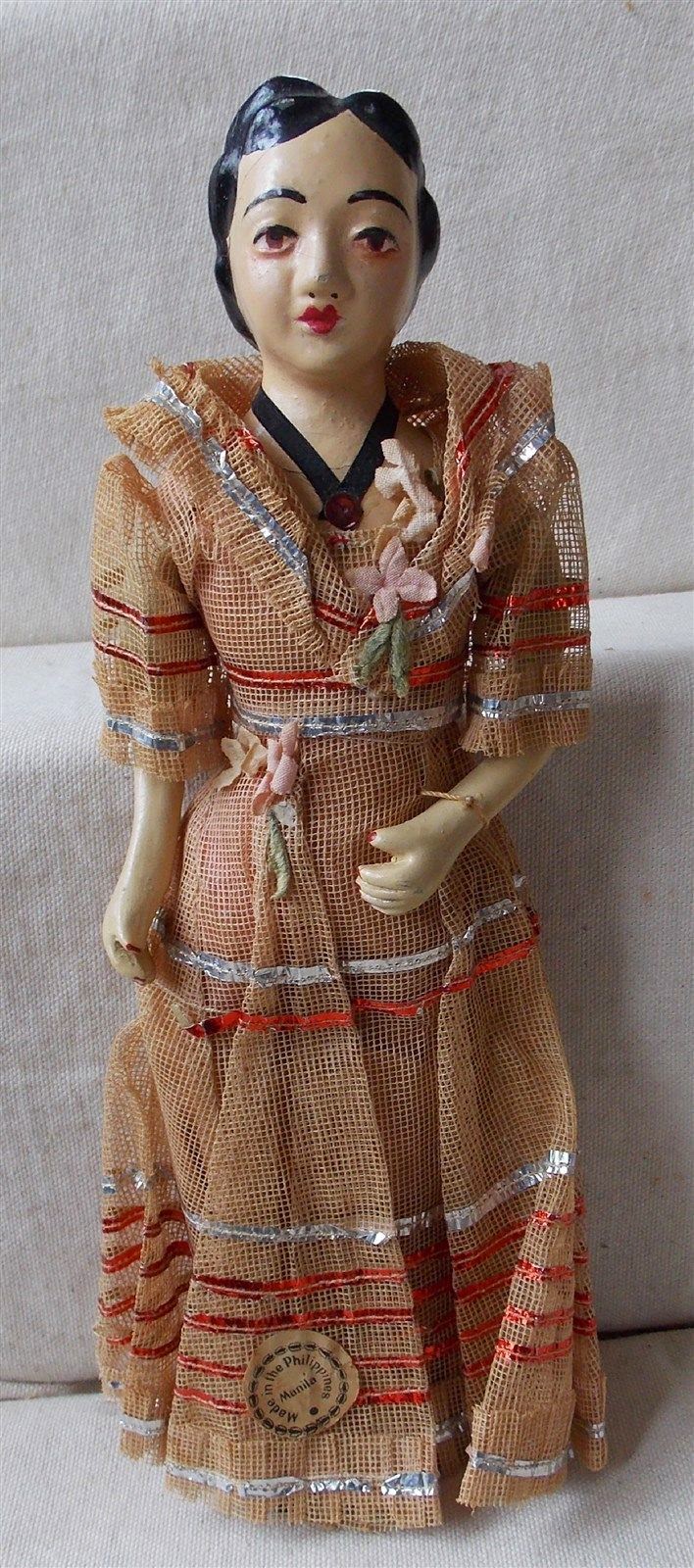
335. Among My Souvenirs: VINTAGE FILIPINA DOLL
In the 1930s--our peacetime era--tourism in the Philippines boomed. many bazaars and curio shops mushroomed in the Malate area, selling Philippine-made souvenirs to domestic and international tourist. Capiz shells, abaca products, woodcarvings, buri hats, banig (mats) and woven jusi and pina fiber were top sellers. For kids,there were a few options--yoyos and pull toys (calesas) for the boys, and for the girls-- Philippine-made dolls of composition with cloth bodies attired in baro't saya, like this example, in very good condition.
These were most likely outsourced from contractors who made these at home, products of Philippine cottage industry. They are very fragile, as the composition tend to crack over time, but this charming doll has retained its color, its dress and even its label. She is dressed in a stiffened abaca skirt and top, with a panuelo to complete her 'dalagang bukid' look.
These vintage Philippine dolls occasionally are seen on ebay--like this small 11 inch creation. Thank heavens, they are not that expensive and demand is not too high, so they are very much affordable. Much rarer are bigger dolls of over a foot in length, made in the same fashion, but with heads of painted clay and more elaborate costumes. Dolls using raw Philippine materials are not just nostalgic souvenirs of childhood but wonderful examples of Philippine folk art.
These were most likely outsourced from contractors who made these at home, products of Philippine cottage industry. They are very fragile, as the composition tend to crack over time, but this charming doll has retained its color, its dress and even its label. She is dressed in a stiffened abaca skirt and top, with a panuelo to complete her 'dalagang bukid' look.
These vintage Philippine dolls occasionally are seen on ebay--like this small 11 inch creation. Thank heavens, they are not that expensive and demand is not too high, so they are very much affordable. Much rarer are bigger dolls of over a foot in length, made in the same fashion, but with heads of painted clay and more elaborate costumes. Dolls using raw Philippine materials are not just nostalgic souvenirs of childhood but wonderful examples of Philippine folk art.
Labels:
1930s,
composition,
doll,
ebay,
Filipiniana,
holiday collectibles,
toy
Friday, October 3, 2014
311. Advertique: PLANTERS PEANUTS' PRES. OF U.S.A. PAINT BOOK
One of the earliest Chirstmas gifts I can remember was a 1960s coloring book of the U.S. Presidents given out by Planter's Peanuts---that peanut company with that ever-present Mr. Peanut mascot gracing the front page. The coloring book, purchased by my Mother from Johnny's grocery in downtown Angeles City, featured all the American presidents--from Washington to Kennedy. It was one of the few color books that I did not keep, so when I found this smaller paint book version--I knew this would be a perfect substitute!
Planters Peanuts was founded by Italian Amedeo Obici in 1906, in Wilkes-Barre, Pennsylvania. In 1916 the company held a contest to create a company logo and the contest was won by a 14 year old . schoolboy named Antonio Gentile who drew a Peanut Man. Artist Frank P. Krize, Sr., improved it by adding a top hat, a monocle, and a cane to the drawing, and Mr. Peanut was born. By the mid-1930s, the raffish figure had come to symbolize the entire peanut industry, appeared on packages, advertising and premium items like this paint book.
The paint book features side-by-side illustrations of the U.S. presidents--one in black and white and one in color, to be used as a color guide. Defining events from the president's term are also drawn; in the case of Pres. Kennedy, the age of space exploration is shown. The paint book is unused and dates before Kennedy's assassination.
Planters Peanut products were available in limited quantities in the Philippines--through the military PX goods mostly. Even today, Planters are imported, available in select groceries and supermarkets like S& R. It just goes to show how popular the brand has become globally, with Mr. Peanut winning acclaim as one of the most recognized character trademark in marketing history.
Planters Peanuts was founded by Italian Amedeo Obici in 1906, in Wilkes-Barre, Pennsylvania. In 1916 the company held a contest to create a company logo and the contest was won by a 14 year old . schoolboy named Antonio Gentile who drew a Peanut Man. Artist Frank P. Krize, Sr., improved it by adding a top hat, a monocle, and a cane to the drawing, and Mr. Peanut was born. By the mid-1930s, the raffish figure had come to symbolize the entire peanut industry, appeared on packages, advertising and premium items like this paint book.
The paint book features side-by-side illustrations of the U.S. presidents--one in black and white and one in color, to be used as a color guide. Defining events from the president's term are also drawn; in the case of Pres. Kennedy, the age of space exploration is shown. The paint book is unused and dates before Kennedy's assassination.
Planters Peanut products were available in limited quantities in the Philippines--through the military PX goods mostly. Even today, Planters are imported, available in select groceries and supermarkets like S& R. It just goes to show how popular the brand has become globally, with Mr. Peanut winning acclaim as one of the most recognized character trademark in marketing history.
Labels:
1960s,
baby boomer,
books,
collectibles,
collecting,
coloring book,
ebay,
ephemera
Thursday, May 8, 2014
298. MINI-ALTAR VESSELS
Miniatures are a big collecting field in the U.S.--there are dolls, furniture, figurines, decor of all sorts--all in Lilliputian size, available to collectors. This set of altar vessels are more unusual, in that they are seldom seen, and if made available, carry quite a hefty price tag. Standing no more than 4 inches tall, the set includes a pair of cruets, ciborium, chalice and what seems to be a reliquary or a monstrance.
Made of cast metal plated in bronze, the sacred vessels date from the early 1900s and were made in France. Similar ones, of pewter or tin, were also manufactured in Germany. Though small, the vessels are highly detailed, with "repousse" designs on their bases. They were designed for use in home altar, for a priest's altar table or even for dollhouses.
Examples sold on ebay are indivudually priced anywhere from $20-$250 each, but I was lucky to stumble upon this 5-piece set, with a very low starting bid. At the end of the bidding period, I had them all for just under $60! Sing hallelujah to the Lord!
Made of cast metal plated in bronze, the sacred vessels date from the early 1900s and were made in France. Similar ones, of pewter or tin, were also manufactured in Germany. Though small, the vessels are highly detailed, with "repousse" designs on their bases. They were designed for use in home altar, for a priest's altar table or even for dollhouses.
Examples sold on ebay are indivudually priced anywhere from $20-$250 each, but I was lucky to stumble upon this 5-piece set, with a very low starting bid. At the end of the bidding period, I had them all for just under $60! Sing hallelujah to the Lord!
Labels:
1900s,
children's toys,
ebay,
miniatures,
religious collectibles
Wednesday, April 30, 2014
297. CROSS IN A BOTTLE
An interesting bottled whimsey that gives a fresh spin to the usual "ship-in-a-bottle" folk art. This crucifixion bottle, an ebay pick, dates from the early 20th century, and is quite an elaborate creation, featuring almost all the symbols of Christ's passion, all carved and cut from pine.
The focal point of the bottle is a large serrated cross, and each facet shows allegorical and symbolic carvings such as a ladder, an anchor, a heart, a cross, and miniature crosses.
This side of the bottle shows a rooster (associated with Peter's denial of Christ), a lance, a hammer, and a whip.
Turn the bottle around and you will see a pair of crossed swords, a shovel and a spear. The cross itself is trimmed with 3 criss-crossed serrated bars. Crucifixon bottles, as these are called in Europe and the U.S. were favorite folk art crafts done by local artisans and ordinary people during their spare time. There are also crucifixion bottles from the Philippines which were believed to have been made by Bilibid prisoners as part of their rehabilitation program. Regardless, all these bottles were made by deft and steady hands, requiring patience and many hours of perseverance to complete such folksy, collectible bottled art.
The focal point of the bottle is a large serrated cross, and each facet shows allegorical and symbolic carvings such as a ladder, an anchor, a heart, a cross, and miniature crosses.
This side of the bottle shows a rooster (associated with Peter's denial of Christ), a lance, a hammer, and a whip.
Turn the bottle around and you will see a pair of crossed swords, a shovel and a spear. The cross itself is trimmed with 3 criss-crossed serrated bars. Crucifixon bottles, as these are called in Europe and the U.S. were favorite folk art crafts done by local artisans and ordinary people during their spare time. There are also crucifixion bottles from the Philippines which were believed to have been made by Bilibid prisoners as part of their rehabilitation program. Regardless, all these bottles were made by deft and steady hands, requiring patience and many hours of perseverance to complete such folksy, collectible bottled art.
Labels:
1900s,
bottles,
crucifixion bottles,
ebay,
folk art,
religious collectibles
Tuesday, February 4, 2014
290. FANTASY PHOTO POSTCARDS
Before the advent of photoshop, salon studios created special effects using amazing scenography, fashioned from cardboard and wooden props to situate the subject in a fantasy place. But even more incredible are these manipulated real photo postcards, several elements cut and pasted on a new background, which was then painted and tinted over.
Painted photos are not unknown in the Philippines as the "foto oleo" technique was known as aearly as the the first decade of the 20th century. Ordinarily, the subject's dress is washed lightly with color, and the details of a baro were defined by paint. But these two photo postcards bearing the names of "Anita" and "Concepcion" were much more elaborate as they combined time-consuming cutting, rephotographing. lettering, painting and tinting. True, the advent of modern photography and computer technology have all but rendered this tedious process obsolete, but nothing can duplicate the artistry of these fantasy--conceived by imaginative minds and crafted by deft, hard-working hands!
Labels:
1910s,
cards,
collectibles,
ebay,
ephemera,
Filipiniana,
old photos,
vintage
Monday, September 30, 2013
275. Heavy Metal: MINERVA METAL HEAD BOY DOLL
One of the most unique material in doll making is tin--a practice that started in the late 19th century, and peaked in the 1920s. Doll heads of metal were considered "indestructible", more durable than porcelain, parian and bisque. Unlike composition, they also did not absorb moisture. One such example I picked up from ebay is this great-looking metal head boy doll in a smart Little Lord Fauntleroy suit. The back of the head is marked "Minerva", a common manufacturer's mark found on such dolls. In reality, these dolls were made by different companies and distributed all over the United States.
This 21 inch doll features a cloth body and composition hands and feet. Other than a few paint losses on the head, it is in good condition. The Fauntleroy costume in brown velvet looks like a later replacement, but it is still a vintage piece. The only drawbacks noted with metal head dolls was the fact that they are affected by temperature changes, absorbing heat and cold. As such, they were not as "cuddable" and "huggable" as other dolls. They don't command much, as they are not popular (I still have to see an example in the Philippines)--which is fine for a collector with a shoestring budget like me!
Labels:
1920s,
automaton,
collectibles,
collecting,
doll,
ebay,
toy
Thursday, May 17, 2012
222. FILIPINO COMIC CHARACTER MASKS
Recently, I got hold of a set of 8 cardboard masks given as premium items to subscribers and readers of Filipino Komiks, a leading comics published in the mid 50s thru the 60s by Ace Publications founded in after the War. These masks depicted characters featured by the comic book in their illustrated stories. Many comic characters were inspired by specific American comics, such as Kulafu and Og (local Tarzan) and the above character--D.I. Trece was the Pinoy version of detective Dick Tracy. The masks still retain their original rubber bands that one had to sling over one's ears. The masks are superbly illustrated and in good condition--in fact, I am wearing this mask as I pound away this entry on my laptop. Today, the comic world is enriched by the drawings and creations of Pinoy 'komiks' artists like Nestor Redondo, Alex Nino, Tony de Zuniga, Francisco Coching, Mars Ravelo and Jim Fernandez. Their original artworks, previously ignored, are now worth quite a bounty based on recent sales and auctions.
Labels:
1950s,
comics,
ebay,
ephemera,
Filipiniana
Thursday, May 10, 2012
221. BINATA'T DALAGA: Filipiniana Souvenir Dolls

I chanced upon this handsome couple on ebay--a Filipino/Filpina pair of dolls complete with detailed Filipiniana costumes. It's rare to find a matching pair sold together, in great condition as well. These kinds of dolls were very popular in the 30s, sold in emporiums and bazaars to Manila tourists as souvenirs. The head, hands and feet are made of fine clay, while the bodies are made of stuffed cloth.
The heads are painted realistically--the young man's head is molded and painted, while the young miss has a black mohair wig curled in the flapper style that was all the rage in the 30s. Both are outfitted with glass eyes.
The dolls are outfitted in authentic Filipiniana outfits made from traditional fabrics. The Filipina doll is exceptional in detailing--she is in a baro't saya, complete with an inner wear called kimona. Over this is gauzy baro with butterfly sleeves with floral appliqués and a stiffened panuelo (piano shawl) held together by a faux gem alfiler (pin). The saya has a long train of the de cola variety. I am not sure if this doll is missing a tapiz, which would be of the same gauze material wrapped around the says. She wears a pair of native corchos or slippers.

The handsome swain is dressed in a simple barong tagalog and a pair of coarse brown pants, with matching tan-colored shoes. I have seen male dolls of this sort made in the likeness of Jose Rizal, maybe a character doll, but this chap looks like your everyday Pinoy binata. Bought as a pair long ago by an American tourist smitten by our islands, these Filipiniana dolls survived 70+ years "living" abroad. Now they are coming back home, a destiny made possible by ebay!
Sunday, February 7, 2010
101. NUN'S HEAD REVISITED
A lady head vase? More like a Mother Superior Head Vase! This is actually a cheap, Japan-made planter, from the 1960s. These are harder to find than the generic lady heads, but are made pretty much the same way--thick, protruding black eyelashes included. Unfortunately, some of the nun's well-polished fingertips have broken off, but this does not detract to the duotone beauty of this nice thrift shop find.
Labels:
1960s,
ebay,
head vases,
houseware,
kitsch,
thrift shop
Monday, September 14, 2009
46. A DOLL WITH HISTORY
This small Filipina doll, made in the 1930s for the tourist trade, was an ebay find. Philippine curios were quite in demand during the American occupation, either bought by visiting tourists or Americans based in the Philippines, for sneding to friends and relatives back home. This doll is typical of those cheap souvenirs peddled by outlets (such as San Juan Store, as the box label shows) all over Manila.
Made of composition and dressed in a native baro't saya, the features of this jointed doll are hand-painted. It is wigged and outfitted with non-blinking glass eyes. The molded head has cracked and the body shows signs of peeling paint. Despite the flaws, this doll has quite a history, as documented by the ebay seller.
Indicated on the box are the pencilled notations: "To the secretary of Gov. Frank Murphy". It turns out that this particular souvenir doll was given as a gift to the secretary of a fomer Governor-General of the Philippines at the time of the Commonwealth. William Frank Murphy (1890-1949) was appointed as a Governor General of the Philippines from 1933-1935--the last American to serve. He also served as the first High Commissioner of the Philippines and after his Philippine assignment, went on to become a Mayor of Detroit, Governor of Michigan and the Attorney General of the U.S. His contributions to his leadership of the Philippines were recognized by way of Fifty Centavo and One Peso Coins minted in 1936 with his likeness.As for his secretary, the recipient of this pretty souvenir, no records of her remain.
Monday, August 24, 2009
29. 'TIPOS DEL PAIS'

When visitors from the West came to visit the Philippines, they found the everyday Pinoy so interesting--from his features to his clothing and the props he carried to make a living. So much so that figurines of "Filipino types" -- the neighborhood vendor, the farmer, the milk peddler, the fisherman -- were produced to satisfy Pinoy-struck, souvenir-hunting Western tourists. I. Beck's at Escolta, the leading department store founded by Jewsih businessman Isaac Beck, made sure it carried stocks of these figurines. Here, you have two charming examples from the shop (the bases are marked "I. Beck's") , from the early 1930s. The pair of 8-inch Filipina types (a water bearer, a 'kakanin' vendor) were molded from escayola or plaster of Paris, a more contemporary material--early tipos del pais figures were carved from wood. Great ebay finds, but I had to pay a little more than a hundred dollars for the two figurines that are quite difficult to find in the country (Remember, these were made for the tourist market.) . The ebay seller wanted to throw in a 3rd slightly damaged figurine for 20$ more, but I had to decline.The spirit was willing but my credit card power is weak.
Labels:
1930s,
collectibles,
collecting,
ebay,
figurines,
Filipiniana,
Philippines,
soda pop collectibles
Thursday, July 30, 2009
15. COMBAT TO COLOR!
Combat was the longest running World War II series on TV, running from 1962-1967. I was a fan of the 2 stars--Vic Morrow (as Sgt. Chip Saunders) and Rick Jason (as Lt. Gil Hanley) and I remember going agog when I received Sgt. Saunder's autographed fan photo from Uncle Bob's Lucky 7 Club. But what I really wanted was a Combat coloring book, which was impossible to get in Manila. Four decades later, thanks to ebay, I found one, published by Saalfield, unused and uncolored! Tada-da-dan, ta dan!
Labels:
1960s,
collectibles,
collecting,
ebay,
TV collectibles
Thursday, July 23, 2009
9. PACMAN, DOLLIFIED.
Pambansang Kamao just got dollified!This is a one-of-a-kind Manny Pacquiao deconstructed action figure made by a Bulacan artist who, using Sculpey ( a kind of mdelling clay) sculpted the likeness of the boxing legend and plunked it on a generic 12 in. vinyl body of some other action toy. Manny wears his trademark shorts (handpainted) and rosary. The boxing gloves and Everlast training helmet cmplete this boxed ensemble. I was surprised that this didn't sell on ebay.ph, even after repeated re-listings. So I snapped it up for under 3K! Definitely, the best pound-per-pound 12 inch action puncher on earth!
Labels:
action figure,
celebrity doll,
collectibles,
collecting,
ebay,
Philippines
Subscribe to:
Posts (Atom)