

Showing posts with label 1920s. Show all posts
Showing posts with label 1920s. Show all posts
Thursday, May 19, 2016
367. NEEDFUL THINGS

Sunday, April 3, 2016
364. Dish and That: MINIATURE TOY DISHES

Friday, March 4, 2016
360. A MENAGERIE OF MINI-DOLLS

Dolls of these kinds are rare in the Philippines because they were rather expensive, way beyond ordinary means of families. The figurines are also of the same material, depicting family scenes and character figures like a fishing boy, grandpa on a chair and dancing ladies. Now, if only i could find a nice little cabinet to house hem all in. That's for another hunt!!
Wednesday, October 21, 2015
348. MUNTING CHERUBIMS: Winged Antique Fragments

Sunday, January 11, 2015
321. Nurse, I Need To Go!: PORCELAIN BEDPAN
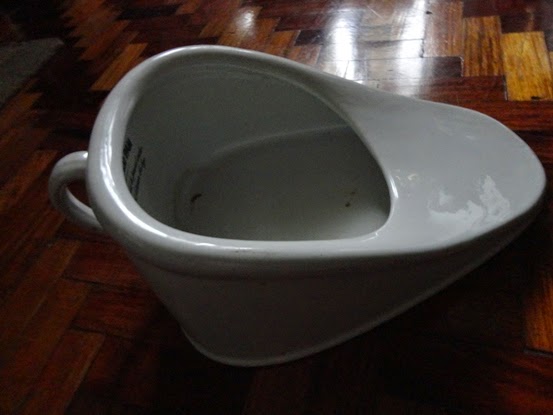
One of the oddest things I found in my scrounging expeditions was this porcelain bedpan, in pristine condition. It is clearly an old piece, and a quick online search yielded a bit of info about this vintage hospital collectible that has the potential to become a "conversation piece".

The slipper bed pan is passed under the patient in front, between the legs, and comes with a handle for easy retrieval.

Wednesday, January 8, 2014
286. BISQUE KIDS

Monday, September 30, 2013
275. Heavy Metal: MINERVA METAL HEAD BOY DOLL

One of the most unique material in doll making is tin--a practice that started in the late 19th century, and peaked in the 1920s. Doll heads of metal were considered "indestructible", more durable than porcelain, parian and bisque. Unlike composition, they also did not absorb moisture. One such example I picked up from ebay is this great-looking metal head boy doll in a smart Little Lord Fauntleroy suit. The back of the head is marked "Minerva", a common manufacturer's mark found on such dolls. In reality, these dolls were made by different companies and distributed all over the United States.

Thursday, September 12, 2013
273. Bear Essential: BABY BEAR PULL TOY

Toys, however, are not exactly hot collectibles in the country, rarely showing up in traditional antique shops. I have seen a few sungkaans lying around, largely ignored--but not old commercial toys from the 20s and 30s that were once staples in downtown bazaars and emporia like I. Beck's, Aguinaldo's and La Puerta del Sol.

He told me, however, he still had a few toys from the 30s, toys which his grandfather had played with, and which now they are trying to dispose. One toy that caught my fancy was this baby bear pull toy; it was a stuffed, plush bear mounted on 2-sized wooden wheels. When pulled, the bear nods forward, which certainly would have delighted kids.

There is no marked on the straw-stuffed, glass-eyed bear; it may be a Steiff or a Schuco, German companies that specialized in stuffed toys. Saved for a few bald patches and a missing screw on one of his paws, the toy was in good shape after all these 70 plus years!!!

Sunday, July 7, 2013
267. A Grate Collectible: ANTIQUE KUDKURAN


Thursday, May 23, 2013
262. LITTLE DRUMMER BOY: A 1920s Mechanical Toy


Saturday, February 9, 2013
252. What Is It?: A MOLD? A MASHER? A KITCHEN TOOL?


Monday, November 19, 2012
244. SANICULAS COOKIE MOLDS

The celebrated miraculous bread, known as “panecillos de San Nicolas”, is known simply in Pampanga as “saniculas’. There used to be a ritual blessing of the cookies before they are distributed, although this tradition is now rarely practiced, saved for some Recollect parishes like San Sebastian where saniculas are still blessed during Masses.The cookie itself is made using age-old techniques and ingredients like arrowroot flour (uraro), eggs, lard, dalayap (lemon rind) and coconut milk.

The “saniculas” wooden moulds which are used to impress the dough with the distinctive imprint are interesting kitchen artifacts themselves. They are often commissioned from Betis and Bacolor carvers, and although the designs vary, the moulds always have the abstracted figure of the saint in the center, surrounded by floral, vegetal and curlicue patterns.
Kapampangan cooks treasure these uniquely-designed wooden molds, which commonly came as single blocks. Some have back-to-back designs, but most are often carved with the owner’s initials. As fine examples of folk art, “saniculas” moulds have also found their way in antique shops.
Wednesday, September 5, 2012
236. E-Z BILT TIN HOUSE

The painted metal parts were in a box that had long since disintegrated, but I distinctly recall that it was marked with a"BILT E-Z" brand name. I assembled the pieces easily and formed this multi-level structure, put it on a shelf and forgot all about it. That is, until I saw a similar tin building featured on a Smithsonian Magazine!
A quick research yielded some information about this toy from the 1920s. The BILT-EZ building was made by Scott Manufacturing Company Inc, Chicago, USA. The parts connect together by means of tabs which project at right-angles from the top and bottom of the wall pieces and slip into the edges of the roof/floor parts. Balconies and lengths of roof edging are also attached with tabs. Roof/floor sections are connected together by means of connector plate.
Here is a youtube video I found of this early tin construction toy:
RARE E-Z BILT TOY
Thursday, December 8, 2011
204. TIN INTERCOLLEGIATE FOOTBALL GAME
 One of the first tin toys that I found at the old Makati Cinema Square is this wood and tin Intercollegiate Football. This is a pre-War toy put out by Hustler in the 1920s, and I understand the piece is still being reproduced today. I remember the price of this original plaything--200 pesos. I bought it but I have never figured out how it works as I have no patience reading the instructions at the back of the metal plate. There are spinning mechanisms and score dials that I can't simply comprehend. I have seen similar pieces on ebay, and the most expensive one is available at a Buy-it-Now price of $249! I bought it for the nice, strong graphics, and of course, for the nostalgia it brings. I may not understand the game of football, but I know a good antique buy when I see one.
Monday, February 7, 2011
163. Playbill: AIDA PROGRAM & PHOTO

Talk about being cultured in the 1920s! Manila Grand Opera House was the center of high culture during the American occupation, the equivalent of today's CCP. It featured Western-style entertainment, showcased Italian artists and local opera productions such as Giuseppe Verdi's "Aida", first performed in Cairo in 1871. It is the story of Aida, an Ethiopian princess who was captured and forced into slavery in Egypt. A military commander, Radames, struggles to choose between his love for her and his loyalty to the Pharaoh. In turn Radames was pursued by the Pharaoh's daughter Amneris, who spurned her advances.

The 1933 Philippine production was headlined by the Manila Chamber Music Society and a stellar cast that included: Mrs. Angela A. de Gonzaga (Aida), Jose Barredo ( Radames), Vicente Vera (Amonasro)--all shown in the photo that was found separately in my flavor-of-the-month Q.C. junkshop. I scored the opera program (pardon the pun) from a Makati paper dealer. Others in the cast: Nelia Manalo (Amneris), Gerado Ayllon (Gran Sacerdote) and Manule Galicano (Amneris' father).
"Aida" has been adapted as a musical by Elton John and Tim Rice in 2000, but Pinoys beat the Broadway cast by 67 years, with their own version of "la grandiosa opera en cuatro actos y siete cuadros" premiering on 21 February 1933.
Monday, May 3, 2010
126. CHILDREN'S PLATE


This antique ironstone baby plate made by HoldFast, a popular maker of plates and other houseware based in East Liverpool. I found this in Bangkal, and it was obvious the dealer recognized it as an antique, as it was hanging on a wall as a decorative plate. The central illustration shows a little boy and girl on a see-saw, who reminded me briefly of the Campbell Kids. HoldFast made many children's dishes, bowls and alphabet plates which featured letters of the alphabet written on the rim of the plate. HoldFast plates and dishes are noted for their durability and for their charming designs which often feature characters from Nursery Rhymes like "Bye, Baby Bunting" and "Pussy Cat, Where Have You Been?". This example is heavy and deep, and dates back from the early 20th century or even earlier. The best thing about it is, it still is serviceable, so now I use it as my breakfast plate!
Subscribe to:
Posts (Atom)



 Posts
Posts


