"Casper, the friendly ghost...the friendliest ghost you know.."
Remember the Harvey Famous Cartoon's friendliest ghost, Casper? He was one of my favorite TV cartoon characters and Saturday mornings aren't just complete without him. To think he was a dead person!! Conceived in the 1930s, by cartoonist Seymour Reit and Joe Oriolo, he was designed to become one of the most famous properties from Famous Studios. Soon, comics of him were being published by Alfred Harvey, founder and publisher of Harvey Comics who eventually purchased the rights to the character. New cartoons were created for The New Casper Cartoon Show in 1963, These cartoons remain important today because of the messages they imparted: the values of friendship, compassion, and acceptance of others.
The popularity of Casper generated many collectible merchandise---from toys, coloring books, gameboards to this adorable 15" Casper Doll, a 1963 Original by Mattel. It's a pull-string talking Casper who says 10 different things: "My Name is Casper". "Ooooooh.
Let's play ghost." "I like you." "I'm a friendly ghost.
Don't be afraid of me". "I'm not afraid.
I'm cold.
Can I stay with you?" "Will you play with". me?.
Casper was resurrected as a movie in 1995, with live action and voice characters, starring Devon Sawa as Casper in human form. I have seen the movie of course, but it's the Harvey 'toon that I miss. Thank God, Casper has come back to haunt me in the form of this talking doll--found in a local thrift shop. The voice is a bit garbled, the body shoddy and worn, but he is still loveable after all these years. Unlike grownups, old ghosts never die, they just become friendlier with age!!! !!
Showing posts with label nostalgia. Show all posts
Monday, March 28, 2016
Friday, September 12, 2014
308. The Midnight Special: CAPT. MIDNIGHT "MYSTERY DIAL CODE-O-GRAPH"
Captain Midnight was a popular U.S. radio series that began in 1938 in Chicago, created by Robert M. Burtt and Wilfred G. Moore. At the onset, "Captain Midnight" was simply an undercover name for pilot Jim "Red" Albright. As an agent, he helped gather information to capture criminals. Captain Midnight was constantly trying to stop the plans of the evil Ivan Shark, remaining his evil nemesis throughout its radio run. He found help in Chuck Ramsey,a member of his Secret Squadron and Patsy Donovan. The series grew in popularity and was broadcast over the Mutual Network beginning in 1940 sponsored by Ovaltine.
The company had been looking for a heroic figure to sponsor their product, Ovaltine, as the country seemed headed for World War. Continuing the tradition of their previous series, Radio Orphan Annie, the company began to integrate coded messages and club identification into the episodes--brass examples of which were given out to viewers as premiums.
The "Mystery Dial Code-o-Graph" , first given in December 1940, was so called because the center of the inner disc was supposed to look like the dial knob of a radio. It was used to send a secret message to listeners about the next program episode. To decode, one had to turn the dial, which proved to be a chore, what with the setting windows located at the back. The secret messages to decode were always given at the end as a "Secret Squadron Signal Session.".
The brass decoder has a slot for Capt. Midnight's picture (missing) and came with a manual, such as the one you see here. This highly prized radio collectible--available on ebay from a low of $69.95 to a high of $139--without a manual, was purchased complete and intact in its own envelope, originally addressed to a young radio fan from New Jersey.
The company had been looking for a heroic figure to sponsor their product, Ovaltine, as the country seemed headed for World War. Continuing the tradition of their previous series, Radio Orphan Annie, the company began to integrate coded messages and club identification into the episodes--brass examples of which were given out to viewers as premiums.
The "Mystery Dial Code-o-Graph" , first given in December 1940, was so called because the center of the inner disc was supposed to look like the dial knob of a radio. It was used to send a secret message to listeners about the next program episode. To decode, one had to turn the dial, which proved to be a chore, what with the setting windows located at the back. The secret messages to decode were always given at the end as a "Secret Squadron Signal Session.".
The brass decoder has a slot for Capt. Midnight's picture (missing) and came with a manual, such as the one you see here. This highly prized radio collectible--available on ebay from a low of $69.95 to a high of $139--without a manual, was purchased complete and intact in its own envelope, originally addressed to a young radio fan from New Jersey.
Labels:
1940s,
advertiques,
brass,
children's toys,
nostalgia,
premium,
TV and Radio collectibles
Thursday, November 8, 2012
243. VINTAGE 3-D FOLK ART PAINTING
Nevertheless, despite this technique, paintings still looked kitschy and naive. But nowadays, period kitsch have been elevated to the status of folk art, Filipiniana style, and this example--sold at a swap shop--carried quite a price tag, many time its original price.Not even the fancy frame can hide the hideous execution of its theme--from the waterfall that cascades down to become a multi-tiered stream, the cockroach-looking carabao and the bahay kubo that looks like a cross between a log cabin and an Ifugao ulog hut. But as they say, one man's awful painting is another man's precious "outsider art".
Labels:
1950s,
decoratives,
Filipiniana,
flea market,
folk art,
nostalgia,
painting,
Philippines
Monday, October 8, 2012
240. Before They Were Famous: ALFIE ANIDO'S YEARBOOK
Remember Alfie Anido? He was one of the so-called Regal babies launched to stardom in the late 70s to 80s (the others were Willima Martinez, Snooky Serna, Jimmy Melendez, Gabby Concepcion, etc.). Well, back in 1973, he was a chubby elementary school graduate whose batchmates include President Noynoy Aquino, designer Pepito Albert and senator Teofisto Guingona III!
That's what I found in his Ateneo Yearbook, which I picked from the recent Greenhills Antiques Fair. Just 14 years old here, Alfie was a member of the Varsity Football. Upon graduation, he remained in Ateneo to pursue a management course.
While in college, he started appearing in commercials and in fashion shows, and was soon discovered for the movies. He was teamed up with former Miss Magnolia finalist, Dina Bonnevie, whom he supported in the 1980 hit camp film "Temptation Island".
Just a day before his 21st birthday, on 30 December 1980, Alfie died, reportedly of suicide. But rumors abound that the Enriles had something to do with his untimely death (he was with Juan Ponce Enrile's daughter, Katrina, at that time). In Enrile's recently published memoir, he revealed that Fabian Ver was behind the rumor linking his family to Alfie's death, a rumor that has become a sort of an urban legend in Philippine showbiz. Who would think that only 7 years before that, Alfie was a happy, chubby, cute young Atenean, with perhaps just his football games in his mind?
That's what I found in his Ateneo Yearbook, which I picked from the recent Greenhills Antiques Fair. Just 14 years old here, Alfie was a member of the Varsity Football. Upon graduation, he remained in Ateneo to pursue a management course.
While in college, he started appearing in commercials and in fashion shows, and was soon discovered for the movies. He was teamed up with former Miss Magnolia finalist, Dina Bonnevie, whom he supported in the 1980 hit camp film "Temptation Island".
Just a day before his 21st birthday, on 30 December 1980, Alfie died, reportedly of suicide. But rumors abound that the Enriles had something to do with his untimely death (he was with Juan Ponce Enrile's daughter, Katrina, at that time). In Enrile's recently published memoir, he revealed that Fabian Ver was behind the rumor linking his family to Alfie's death, a rumor that has become a sort of an urban legend in Philippine showbiz. Who would think that only 7 years before that, Alfie was a happy, chubby, cute young Atenean, with perhaps just his football games in his mind?
Labels:
1970s,
books,
flea market,
Greenhills Antique Fair,
nostalgia,
old photos,
souvenir,
vintage,
yearbook
Thursday, August 16, 2012
234. WE THREE KINGS: Nativity Figures
Christmas is still a long way off, but I just have to show this trio of plastic royalties that dates back to the psychedelic 60s. I found these in the weekend Avondale Market in Auckland, NZ--which is basically a farmer's market with a sprinkling of open stalls selling vintage stuff. Melchior, Gaspar and Balthazar may have been part of a Nativity set, typical of examples cheaply sold in the 50s and 60s. I couldn't find a manufacturer's mark, maybe these were made in Hong Kong. Holiday collectibles such as these have their own crazy collectors--and I guess I am one of them. Right now, this merry plastic trio are gathered 'round my little plastic Christmas tree that is displayed year-round in my little house, ready to welcome visitors with their plastic gifts of myrrh, gold and frankincense.
Labels:
1960s,
Christmas,
figurines,
New Zealand,
nostalgia,
plastic collectible
Saturday, July 21, 2012
231. God Wave The Queen: SOLAR QUEEN LIZ
2012 marked Queen Elizabeth of England’s Diamond Jubilee Year and as a tribute, this limited edition ‘Solar Queen’was created by Kikkerland Design of USA and Canada—made in good ol’China, of course.
My sis, who vaguely appreciates my bizarre hobby, sent this animated doll to me from her New Zealand home base. How does it work?
Well, just place the Solar Queen in the sunlight and watch Her Majesty wave with a subtle twist of the wrist. This gesture, cultivated over the centuries, is the true mark of royalty. The solar panel on her handbag is her power supply, so she never needs batteries—which means she may just wave forever!
My sis, who vaguely appreciates my bizarre hobby, sent this animated doll to me from her New Zealand home base. How does it work?
Well, just place the Solar Queen in the sunlight and watch Her Majesty wave with a subtle twist of the wrist. This gesture, cultivated over the centuries, is the true mark of royalty. The solar panel on her handbag is her power supply, so she never needs batteries—which means she may just wave forever!
Labels:
2000s,
celebrity doll,
commemorative,
doll,
nostalgia,
souvenir
Sunday, July 15, 2012
230. AMORSOLO ART IN A SCHOOLBOOK
I was scavenging for old reading materials at a thrift shop at the famous Cubao Expo when this book with a familiar green cover caught my eye. Yes! It’s the same textbook we used in Grade 4, if I remember right—entitled “Your Country and Mine”.
It was authored by Catalina Velasquez-Ty, Tomas Garcia and Antonio A. Maceda, published in 1954 by Ginn and Company, a well-known American publishing firm that had offices in Boston, new York and—Manila!
Once I leafed through the pages, I was transported back to my grade school days, when I used to admire the beautiful full color artworks that appeared in the book.
Little did I know that the illustrations were done by Cesar C. Amorsolo (b.1903/d. 1998) – Fernando Amorsolo’s nephew. His father, Atty. Alejandro Amorsolo also painted. Orphaned at the age of 6, Cesar went on to live with his uncle Fernando, whom he would serve as his assistant for 30 years.
Coming into his own, he painted in Manila, Hong Kong and Los Angeles, where he stayed for 7 years. Gifted with a fine hand, his paintings of rural scenes carry the same unmistakable Amorsolo lighting. Ginn and Co. often commissioned him to do artworks for their books printed in Manila, doing illustrations in oil, pastel and occasionally, watercolor. Cesar Amorsolo belongs to the so-called Mabini artist group who painted in the folk genre for the tourist trade.
It was authored by Catalina Velasquez-Ty, Tomas Garcia and Antonio A. Maceda, published in 1954 by Ginn and Company, a well-known American publishing firm that had offices in Boston, new York and—Manila!
Once I leafed through the pages, I was transported back to my grade school days, when I used to admire the beautiful full color artworks that appeared in the book.
Little did I know that the illustrations were done by Cesar C. Amorsolo (b.1903/d. 1998) – Fernando Amorsolo’s nephew. His father, Atty. Alejandro Amorsolo also painted. Orphaned at the age of 6, Cesar went on to live with his uncle Fernando, whom he would serve as his assistant for 30 years.
Coming into his own, he painted in Manila, Hong Kong and Los Angeles, where he stayed for 7 years. Gifted with a fine hand, his paintings of rural scenes carry the same unmistakable Amorsolo lighting. Ginn and Co. often commissioned him to do artworks for their books printed in Manila, doing illustrations in oil, pastel and occasionally, watercolor. Cesar Amorsolo belongs to the so-called Mabini artist group who painted in the folk genre for the tourist trade.
Labels:
1950s,
books,
Filipiniana,
nostalgia,
Philippines,
vintage
Wednesday, May 30, 2012
224. Thrift Shop Art: VICTOR CABRERA PAINTINGS
GREEN AND BARE IT. Two small paintings of Victor Cabrera, ca. late 50s to early 1960s, found at a Quezon City junk shop.
In my recent forays to the junk shops of Cubao, I was rewarded with these two small paintings--one, a nude lady by the bank of the stream, and another, a more modest beauty, doing her laundry by the river, a little girl beckoning her, at the opposite pampang (river bank). The themes and even the colors were very vintage 50s. I quickly checked the artworks--and one was actually signed on the lower right hand corner. Since the paintings came together and they were stylistically similar, I concluded that these were painted by the same artist.
At first, I thought the painter was a certain "Fabroja", but a quick reference search yielded the name Victor T. Cabrera (b. 1915/ d. 1975) of Dongan, Paranaque. He was actually a student of Fine Arts at UP, but dropped out because of an early marriage. He eventually went back to painting in his 30s, and caught up with lost time by training with Vicente Manansala (they worked together as illustrators for Photo News in the 30s) and Antonio Dumlao, who enlisted him as one of his studio commercial illustrators.
A well-travelled artist, Victor went to Europe and the America, accepting portrait commissions from passengers while en route to his destination. He always finished the artworks even before reaching the port. His works--landscapes, portraits, historical paintings--were characterized by " a silky, finished quality", evident in these two creations.
He painted more earnestly upon his retirement in 1962--the period where these paintings were most likely completed. He had already scheduled his first one-man show at the Great Wall Gallery in 1975, but he died; his exhibit proceeded anyway. Art runs in Cabrera's family--his son-in-law is the noted cartoonist and illustrator, Ben Alcantara, who created the famous "Gorio and His Jeepney" comic strip fro Manila Times.
In my recent forays to the junk shops of Cubao, I was rewarded with these two small paintings--one, a nude lady by the bank of the stream, and another, a more modest beauty, doing her laundry by the river, a little girl beckoning her, at the opposite pampang (river bank). The themes and even the colors were very vintage 50s. I quickly checked the artworks--and one was actually signed on the lower right hand corner. Since the paintings came together and they were stylistically similar, I concluded that these were painted by the same artist.
At first, I thought the painter was a certain "Fabroja", but a quick reference search yielded the name Victor T. Cabrera (b. 1915/ d. 1975) of Dongan, Paranaque. He was actually a student of Fine Arts at UP, but dropped out because of an early marriage. He eventually went back to painting in his 30s, and caught up with lost time by training with Vicente Manansala (they worked together as illustrators for Photo News in the 30s) and Antonio Dumlao, who enlisted him as one of his studio commercial illustrators.
A well-travelled artist, Victor went to Europe and the America, accepting portrait commissions from passengers while en route to his destination. He always finished the artworks even before reaching the port. His works--landscapes, portraits, historical paintings--were characterized by " a silky, finished quality", evident in these two creations.
He painted more earnestly upon his retirement in 1962--the period where these paintings were most likely completed. He had already scheduled his first one-man show at the Great Wall Gallery in 1975, but he died; his exhibit proceeded anyway. Art runs in Cabrera's family--his son-in-law is the noted cartoonist and illustrator, Ben Alcantara, who created the famous "Gorio and His Jeepney" comic strip fro Manila Times.
Labels:
1960s,
decoratives,
Filipiniana,
nostalgia,
painting,
thrift shop,
vintage
Thursday, May 24, 2012
223. A PAIR OF CARVED IGOROT BUSTS
I found this mid-century pair of carved Igorot (people of Northern Luzon, in the Philippines) busts on ebay, of all places. They were being offered by a collector who had an amazing ethnic and tribal collection from the world over. One look and I knew these pieces were the works of a master carver.
The details are simply incredible---the features are very lifelike, capturing realistically the facial features of the hardy Igorot. The hair strands are carved very finely, individually and the proportions are perfect.
Carvings such as these were very popular in the 1930s, sold primarily as souvenir items from the mountain highlands. The peak of woodcarving skills was in the 1950s, the decade in which these handsome pair were carved. They must have come from a premier shop in Manila, as these were commercially stamped with "Made in the Philippines".
These 13" busts retain their dark, rich patina indicating their age. They must have been lovingly polished and cared for thru the years, displayed in an American home, a reminder of a far-away trip in the cool northern mountains of tropical Philippines. As one who lived and studied in Baguio, I was drawn to these busts, not just for the artistry they convey but also for the nostalgia they evoke of my memorable years up the mountains.
Labels:
1950s,
decoratives,
figurines,
Filipiniana,
nostalgia,
vintage,
woodcarving
Wednesday, April 25, 2012
219. J.K. STRAUS JIGSAW PUZZLE

Jigsaw puzzles are staples of childhood, meant not only to amuse and keep the child quiet but also train him in mind and manual dexterity. Jigsaw puzzles were often made of paper and cardboard, but old one were made from jigsaw-cut wood, like those made by Joseph K. Straus of Brooklyn, New York, which was active in jigsaw puzzle production from 1933-1974. The pieces were made from cheap wood that tended to chip and splinter.Joseph Straus set up his own puzzle business along with his wife, in Brooklyn, NY in 1933. The company became known for its basic no-frills puzzles sold at affordable prices.

Well, one of his puzzles reached the Philippines--and here it is, an interlocking puzzle made from about 100 pieces. Entitled "Home Sweet Home" (no. 233) , the completes scene shows an American family, relaxing in front of their fireplace, with the doting father playing with his kids. The puzzle came in a plain red boxes with no picture, which dates this to the 1930s (by the late '40s they were using plain blue, tan or mottled boxes with a small guide picture on the cover.)
"Home Sweet Home" is pretty much a standard puzzle but Straus would produce more complex lines such as sculptured puzzles cut in 2 layers; outline puzzles with much of the background cut away; round, triangle, and other shaped puzzles plus limited edition puzzles. They also sold puzzles under the F.A.O. Schwartz label. The firm closed in 1974 when the last family member retired. Straus puzzles are not very expensive even on ebay, ranging from $5-$20. This example falls within that range even if bought locally. It was a cinch to do--as I completed the puzzle in under 20 minutes. Yawn! So much for hours of amusement!
Sunday, March 18, 2012
216, RUBBER SQUEAKER DOLLS
I haven't the slightest idea why I got these two vintage rubber dolls that probably date from the mid 60s. I've always been a sucker for old toys, especially those that squeak, toot or cry "Mama". They were made by separate makers, although almost of the same height, around 16". The first one depicts a baby boxer, a concept that's hard to understand--why would someone subject a baby to uppercuts, left hooks and killer punches? I thought it's a charming doll--its squeaker still works when the rubber doll is squeezed. It's a rather unusual subject for a toy, 'no?
The other doll is more familiar to me--it's Pinocchio! To underscore the fact that this is a squeaker doll, Pinocchio even holds a horn. A quick ebay search yielded a similar toy figure and I found out that this was made in Italy and that. indeed, it dates from the 60s. The example on ebay has a price tag of $85, which is really too much to pay for a doll of this kind. Rubber dolls don't keep well, and they tend to sag after some time. These two examples are in fair condition, not dirt cheap by my standards, but still a good buy. Guess you could say I'm a rubber lubber. Squeak-squeak.
Labels:
1960s,
character doll,
doll,
nostalgia,
thrift shop,
toy,
vintage
Thursday, December 8, 2011
204. TIN INTERCOLLEGIATE FOOTBALL GAME
One of the first tin toys that I found at the old Makati Cinema Square is this wood and tin Intercollegiate Football. This is a pre-War toy put out by Hustler in the 1920s, and I understand the piece is still being reproduced today. I remember the price of this original plaything--200 pesos. I bought it but I have never figured out how it works as I have no patience reading the instructions at the back of the metal plate. There are spinning mechanisms and score dials that I can't simply comprehend. I have seen similar pieces on ebay, and the most expensive one is available at a Buy-it-Now price of $249! I bought it for the nice, strong graphics, and of course, for the nostalgia it brings. I may not understand the game of football, but I know a good antique buy when I see one.
Labels:
1920s,
collecting,
nostalgia,
thrift shop,
tin toys,
toy,
vintage
Sunday, October 2, 2011
203. Boxed: ANNIE
Little Orphan Annie was a popular U.S. comic strip created by Harold Gray (1894–1968) and syndicated by Tribune Media Services. The strip took its name from the 1885 poem "Little Orphant Annie" by James Whitcomb Riley, and made its debut on August 5, 1924 in the New York Daily News. By 1937, it was rated #1 comic strip. As expected, it inspired a radio show in 1930, film adaptations by RKO in 1932 and Paramount in 1938 and a Broadway musical Annie in 1977. The original production ran from April 21, 1977 to January 2, 1983 and was staged internationally. "Annie" has also been adapted to film twice, in 1982 and in 1999 the better known being perhaps the former, directed by John Huston and starring Aileen Quinn as Annie, Albert Finney as Warbucks, Ann Reinking as his secretary Grace Farrell, and Carol Burnett as Miss Hannigan. (Lea Salonga also was our very own Pinoy 'Annie" and this role would forever be associated with her). Songs from the musical include "Tomorrow" and "It's the Hard Knock Life".
Capitalizing on the broad appeal of this carrot-haired girl who sang "The sun will come out tomorrow", like there was no tomorrow, Aldaddin issued this metal lunchbox in 1981, complete with a plastic thermos. This vintage example, with a current market price from $35-$50-- has never been used and is in impeccable condition, so bet your bottom dollar that tomorrow, it is certain to increase in value!
Labels:
1980s,
houseware,
lunchbox,
movie collectible,
nostalgia
Thursday, September 22, 2011
195. His Own Paint Book: MICKEY ROONEY
The child wonder of the silver screen of the 30s and 40s was born born Joseph Yule, Jr. in Brooklyn, New York, to a vaudeville family. At 14 months old, he crawled on stage wearing overalls and a little harmonica around his neck. His father, Joe Sr., picked him up and introduced him to the audience as Sonny Yule. He began performing officially at the age of 17 months as part of his parents' routine, wearing a specially tailored tuxedo. At 3, he was cast by Hal Roach to participate in the Our Gang series in Hollywood at $5 a day.Soon, Joe Jr. was getting bit parts in films, working with established stars such as Joel McCrea, Douglas Fairbanks, Jr. and Jean Harlow. While selling newspapers, he also enrolled at the Hollywood Professional School, where future stars like Nanette Fabray, Judy Garland, Lana Turner went. In 1938, he graduated from Hollywood High School. He got his name "Mickey" from the "Mickey McGuire" short film series in which he was featured in 1925.
He popularized the character "Andy Hardy" with Judy Garland in 1937 and which made him a superstar. He an Honorary Academy Award, a Golden Globe and an Emmy Award. He has had one of the longest careers of any actor, to date spanning almost 90 years actively making films in ten decades 1920's to 2010's. He is the last surviving male star from 1930s Hollywood.
This paint book dates from his juvenile years when Mickey was at the peak of his career. It's a large (10 1/4" x 16") vintage coloring book printed by Merrill Publishing Company, Chicago in 1940, # 3496", with over 30 coloring pages.
Labels:
1940s,
books,
collecting,
ephemera,
movie collectible,
nostalgia
194. CHINA HEAD DOLLS
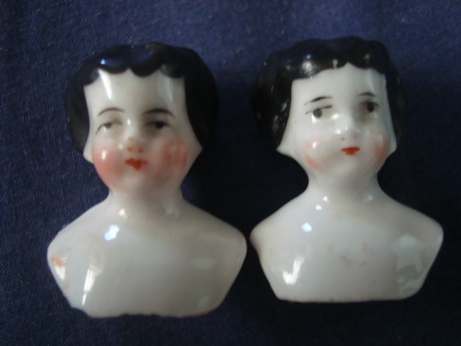
A pair of teensy-weensy china head dolls, no more than 3/4 inch high. They date from 1910-20 and are made in Japan, though the best and finest examples are from Germany. Painted china head dolls also came with separate arms and legs which could be assembled by an adept sewer on a cloth body, then dolled up in the latest fashion. These heads are so small, the dolls would probably measure about 5-6 inches when completed. I found them at Makati Cinema Square (whic sadly, is about to go!) and at the moment, I have no plans though of making cloth bodies for them--they're better off kept and seen in my shadow box, where they wll repose most likely for the rest of their doll lives.
192. RIN TIN TIN Magic Erasable Pictures
The Adventures of Rin Tin Tin, aired from October 1954 to May 1959 on ABC Television. The star was German Shepherd dog descended from the original Rin Tin Tin raised by American serviceman Lee Duncan who became popular in earlier 1920s films. The canine's adventures were adapted for TV and "Rinty" shared billing with child actor Lee Aaker as Rusty, a boy orphaned in an Indian raid, and who was being raised by the soldiers at Fort Apache, a US Cavalry. Rusty and Rin Tin Tin helped the soldiers to establish order in the American West. Texas-born actor James Brown (1920–92) appeared in every episode as Lieutenant Ripley "Rip" Masters.
Transogram came out with a boxed kit of Rin Tin Tin Magic Erasable Pictures at the height of the show's popularity. There were actually several boxed activity kits issued in the 50s--including a Paint by Number set and a gameboard. But this picture playset that dates from 1957 is the rarest. The activity kit featured 12 panels that could be colored with crayons and then erased with a tissue and then colored again.
The panels carried illustrations of the major scenes and characters from the TV show. A box of crayons and a sharpener came along with the boxed kit. The best thing about this Rinty's collectible is that it's unused! A similar kit in unsued condition (saved for a split corner in the box) was priced at $175 on ebay. In the field of TV collectibles, Rin Tin Tin is sure one hot dog!
Sunday, August 7, 2011
187. CORONATION COLORING BOOKS
On 2 February 1953, Princess Elizabeth was crowned Queen of the United Kingdom, Canada, Australia, New Zealand, South Africa, Ceylon, and Pakistan, and named as Head of the Commonwealth after her father's death, the late King George VI, on 2 June 1952. Over eight thousand invited guests attended the historic coronation at the Westminster Abbey. Commemorative souvenirs were made by the hundreds of thousand to mark the ascension of a new monarch--and this very nice coloring book was just one example produced in the U.S. The Coronation Coloring Book has the painted portait of the new Queen on the front cover, while inside, there are pages and pages of illustrations of the various stages of coronation for kids to color.
This second example is an unauthorized 50s edition paint book that features generic coronation scenes, obviously capitalizing on the Queen Elizabeth fever. It is a thin book, made in Britain, and most likely cost a pence or so. Royal commemoratives are making a comeback after the recent wedding of Prince William and Kate Middleston this year. They may have mugs, plates, tea sets, key chains and coins--but did they have coloring books? I bet none!
Labels:
1950s,
books,
collectibles,
commemorative,
ephemera,
nostalgia,
vintage
Tuesday, April 12, 2011
171. PHILIPPINE MOVIE STARS FAN PHOTOS
From LEFT TO RIGHT: Lucita Goyena (late 30s star who was a favorite leading lady of Fernando Poe Sr.), Corazon Noble (known today as Jay Ilagan's mother) and Elsa Oria ("Singing Sweetheart of the Philippines who starred in many musicals).
From LEFT TO RIGHT: Leopoldo Salcedo ("The Great Profile", Lionel Barrymore of the Phils.), Fernando Poe Sr. (FPJ's father who died of rabies in 1953) and Rogelio de la Rosa (Philippines' most famous actor of the 50s, future ambassador and senator).
Labels:
1950s,
Filipiniana,
movie collectible,
nostalgia,
old photos,
vintage
Monday, February 7, 2011
163. Playbill: AIDA PROGRAM & PHOTO

Talk about being cultured in the 1920s! Manila Grand Opera House was the center of high culture during the American occupation, the equivalent of today's CCP. It featured Western-style entertainment, showcased Italian artists and local opera productions such as Giuseppe Verdi's "Aida", first performed in Cairo in 1871. It is the story of Aida, an Ethiopian princess who was captured and forced into slavery in Egypt. A military commander, Radames, struggles to choose between his love for her and his loyalty to the Pharaoh. In turn Radames was pursued by the Pharaoh's daughter Amneris, who spurned her advances.

The 1933 Philippine production was headlined by the Manila Chamber Music Society and a stellar cast that included: Mrs. Angela A. de Gonzaga (Aida), Jose Barredo ( Radames), Vicente Vera (Amonasro)--all shown in the photo that was found separately in my flavor-of-the-month Q.C. junkshop. I scored the opera program (pardon the pun) from a Makati paper dealer. Others in the cast: Nelia Manalo (Amneris), Gerado Ayllon (Gran Sacerdote) and Manule Galicano (Amneris' father).
"Aida" has been adapted as a musical by Elton John and Tim Rice in 2000, but Pinoys beat the Broadway cast by 67 years, with their own version of "la grandiosa opera en cuatro actos y siete cuadros" premiering on 21 February 1933.
Labels:
1920s,
ephemera,
Filipiniana,
music,
nostalgia,
Philippines
Tuesday, January 18, 2011
159. Boxed: THE OSMONDS
Take your lunch with Donny. Or Jay. Or Merrill. Or Alan. Or with the whole toothy Osmonds Bunch. This is a 1973 tin lunchbox made to honor the Osmond teen throbs that gave the Jacksons a run for their money. Still in good shape, despite some nicks and dings. The thermo is missing though. There's a rarer vinyl version featuring Donny and Marie, but this one looks better. In pristine condition, this lunchbox is worth about $75. Who cares if you have only a "One Bad Apple"? Take it to school in this spiffy lunchbox made by Aladdin Industries!
Labels:
1970s,
lunchbox,
music,
nostalgia,
pop culture,
TV collectibles,
vintage
Subscribe to:
Posts (Atom)