Saturday, June 27, 2015
337. ATOMIC MIDCENTURY CLOCK
In the 50s, free-form shapes became very popular--pieces of furniture and other decor items assumed the shapes of kidneys, boomerangs and amoeba. This funky-looking, fully-functioning clock followed that trend with its irregularly-shaped, vinyl colored body. I got this in a flea market in China, where wind-up clocks of this shape and form are still being produced. This clock is still tick-tick ticking after over 50 years, to remind us of the atomic age that changed the way we live, and the way we watched time passed by!
Labels:
1950s,
clocks,
industrial collectible,
midcentury,
retro
Saturday, June 20, 2015
336. TUMBLING CLOWN ACROBATS
Look at these "Tumbling Clown" plastic acrobat mechanical toys that I found with original box intact. Dating from the 60s, they were made by a plastic toy firm in Malabon--proudly Philippine made!
The pieces are surprising intact after all these years, save for a missing plastic tab or two. The assembly is very simple--one had to snap together the plastic framework pieces to form a sort of a tower.
Then, all you had to do was set the clowns--which were connected together with a see-saw-like crosspiece--on the topmost ramp of the tower. A little nudge will cause the clowns to "tumble" down in a teeter-totter motion, complete with a jingle-jangle sound--no batteries, no electricity needed! Just plain, simple fun! Just the way childhood should be!
Now, let me do that again....
Labels:
1950s,
children's toys,
collectibles,
Filipiniana,
plastic collectible,
playthings,
vintage
Wednesday, June 10, 2015
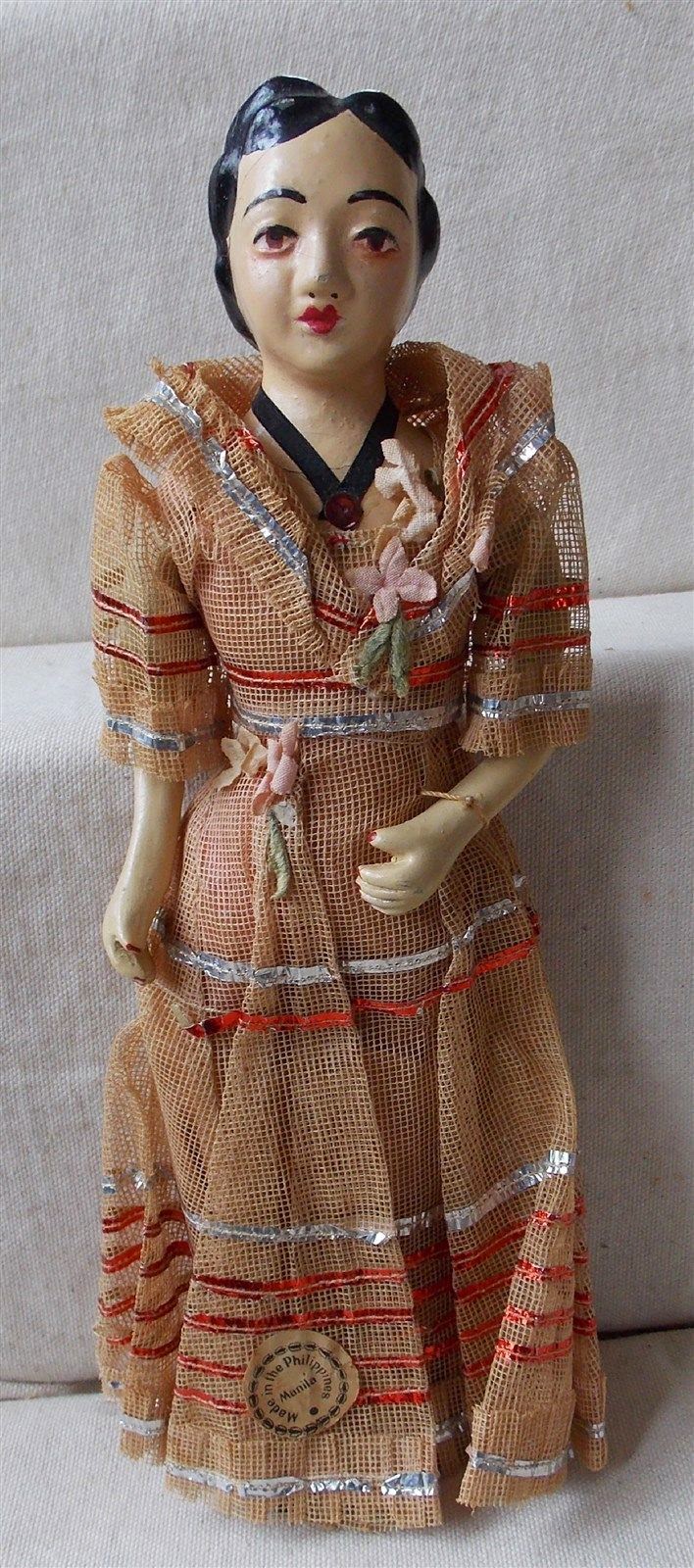
335. Among My Souvenirs: VINTAGE FILIPINA DOLL
In the 1930s--our peacetime era--tourism in the Philippines boomed. many bazaars and curio shops mushroomed in the Malate area, selling Philippine-made souvenirs to domestic and international tourist. Capiz shells, abaca products, woodcarvings, buri hats, banig (mats) and woven jusi and pina fiber were top sellers. For kids,there were a few options--yoyos and pull toys (calesas) for the boys, and for the girls-- Philippine-made dolls of composition with cloth bodies attired in baro't saya, like this example, in very good condition.
These were most likely outsourced from contractors who made these at home, products of Philippine cottage industry. They are very fragile, as the composition tend to crack over time, but this charming doll has retained its color, its dress and even its label. She is dressed in a stiffened abaca skirt and top, with a panuelo to complete her 'dalagang bukid' look.
These vintage Philippine dolls occasionally are seen on ebay--like this small 11 inch creation. Thank heavens, they are not that expensive and demand is not too high, so they are very much affordable. Much rarer are bigger dolls of over a foot in length, made in the same fashion, but with heads of painted clay and more elaborate costumes. Dolls using raw Philippine materials are not just nostalgic souvenirs of childhood but wonderful examples of Philippine folk art.
These were most likely outsourced from contractors who made these at home, products of Philippine cottage industry. They are very fragile, as the composition tend to crack over time, but this charming doll has retained its color, its dress and even its label. She is dressed in a stiffened abaca skirt and top, with a panuelo to complete her 'dalagang bukid' look.
These vintage Philippine dolls occasionally are seen on ebay--like this small 11 inch creation. Thank heavens, they are not that expensive and demand is not too high, so they are very much affordable. Much rarer are bigger dolls of over a foot in length, made in the same fashion, but with heads of painted clay and more elaborate costumes. Dolls using raw Philippine materials are not just nostalgic souvenirs of childhood but wonderful examples of Philippine folk art.
Labels:
1930s,
composition,
doll,
ebay,
Filipiniana,
holiday collectibles,
toy
Tuesday, June 2, 2015
334. Space Wars: BUCK ROGERS BOARDGAME
Buck Rogers first appeared in a short novel published by Philip Francis Nowlan in an August 1928 issue of the pulp magazine "Amazing Stories". Entitled "Armageddon", it featured a hero,Anthony Rogers, later renamed Buck Rogers when it was bought by the National Newspaper Syndicate. comic made its first newspaper appearance in 1929 . The adventures of Buck Rogers in comic strips, movies, radio and television became an important part of American popular culture. It's been credited with bringing into popular media the concept of space exploration. Buck Rogers' last incarnation was as a film in 1979 and as a TV series in 1981, starring Gil Gerard. Many merchandise such as toys and playthings were spawned by the TV serial--and this 1930s gameboard is just one of the hundreds of thousands that children played with. It's one of those basic "race" games--the movement is controlled by a throw of a dice or a spinner, with obstacles provided by "alien enemies" along the way.There were 3 game versions:"Cosmic Rocket Wars", "Search for the Secrets of Atlantis" and "The Siege of Gigantica".
Monday, May 25, 2015
333. Rising in Value: PHOENIX PLATE
One of my first oriental antiques is this so-called 6.5" diameter Phoenix Plate which I bought in the 80s at the famous Aldevinco Shopping Center in Davao--known for its excavated and salvaged antiques. It shows the legendary bird, hand-drawn in the middle of the plate, flying off in resurrection. Alongside dragons and roosters, the phoenix is a popular theme in Oriental art.
In mytholology, it is a long-lived bird that cyclically reborn--thus the phoenix is associated with the Resurrection of Christ. In Art, it is depicted as a very colorful bird, the size of an eagle with a nimbus to symbolize its association with the Sun.
This particular Phoenix Plate is made of glazed clay; I have no idea as to its age, but it does look and feel very old. I've had this sitting on a shelf for s long, surviving typhoons and earthquakes from the last three decades. I am not worried it might break because for sure--like the mythical phoenix--it will become whole and rise again!
In mytholology, it is a long-lived bird that cyclically reborn--thus the phoenix is associated with the Resurrection of Christ. In Art, it is depicted as a very colorful bird, the size of an eagle with a nimbus to symbolize its association with the Sun.
This particular Phoenix Plate is made of glazed clay; I have no idea as to its age, but it does look and feel very old. I've had this sitting on a shelf for s long, surviving typhoons and earthquakes from the last three decades. I am not worried it might break because for sure--like the mythical phoenix--it will become whole and rise again!
Labels:
Aldevinco Davao,
antiques,
ceramics,
collecting,
Filipiniana,
Orientalia,
porcelain,
pottery
Wednesday, May 20, 2015
332. Advertiques: PHILLIPS PETROLEUM 66
Loyalty has its privileges, indeed. I bought a few items from an antique dealer recently and he gave me this freebie--a rather large wooden sign of Phillips Petroleum 66. The energy company was founded by Lee Eldas "L.E." Phillips and Frank Phillips of Oklahoma in 1917.
A shield logo was created in 1930 for its link to the famous highway of the same number, with a black and orange color scheme that would last nearly 30 years. In 1959, Phillips introduced a revised version of the shield in red, white and black, a color scheme still used by Phillips 66 Co. for the brand. Vintage Phillips signs are highly collectible and many reproductions exist. This wooden sign is definitely a local fantasy version, with cut-out letters and carved background (there's a missing piece below). It must have hanged in a private bar or used to decorate a den or a man-cave. I haven't gotten around to restoring it--it is just stashed away in my garage-- to remind me that once upon a time, petrol was so cheap, that everyone on Route 66 was screaming--"Step on the gas!".
Labels:
advertiques,
Filipiniana,
industrial collectible,
Pampanga,
woodcarving
Saturday, May 9, 2015
331. Grind, Grind: HEIRLOOM STONE GILINGAN
Before you start picking for antiques, why not try looking around your own house first? This is just what I did when I started getting hooked on old things. Ever since I can remember, we've always had this stone grinder at home, which was actually used for years in the making of bibingka, tamales and other sweet kakanins (homemade delicacies).
One used a spoon to "feed" the stone grinder with gelatinous rice and water, through a small opening on the top stone wheel. The brass handle is then turned by hand, and the ground rice then comes out of the spout, with a sticky consistency now called "galapung"--the main ingredient in many Filipino sweet treats. This domestic antique bears the name of the original owner, who happens to be the elder brother of my grandpa--Dr. Melecio R. Castro,
The date is carved out on the top stonewheel--Enero 15, 1913--which makes this gilingan a certified antique--over 100 years old! I am glad I saved our stne grinder, which went out of commission many years ago, with the advent of instant "galapung" flour. It still is in great condition, with its original brass turner, that is connected to the stone with a tongue or hardwood, It rests now in my garage, treated like a sculptural piece, the way gilingans are being collected these days as garden ornaments. Hopefully, I will find the opportunity to use this again, to make my favorite tamales. Giling-giling, pag may time!
One used a spoon to "feed" the stone grinder with gelatinous rice and water, through a small opening on the top stone wheel. The brass handle is then turned by hand, and the ground rice then comes out of the spout, with a sticky consistency now called "galapung"--the main ingredient in many Filipino sweet treats. This domestic antique bears the name of the original owner, who happens to be the elder brother of my grandpa--Dr. Melecio R. Castro,
The date is carved out on the top stonewheel--Enero 15, 1913--which makes this gilingan a certified antique--over 100 years old! I am glad I saved our stne grinder, which went out of commission many years ago, with the advent of instant "galapung" flour. It still is in great condition, with its original brass turner, that is connected to the stone with a tongue or hardwood, It rests now in my garage, treated like a sculptural piece, the way gilingans are being collected these days as garden ornaments. Hopefully, I will find the opportunity to use this again, to make my favorite tamales. Giling-giling, pag may time!
Labels:
1910s,
antiques,
Filipiniana,
heirloom,
houseware,
Philippines
Subscribe to:
Posts (Atom)